 English
  Български
  Deutsch
  العربية
  Čeština
  Dansk
Dansk  Ελληνικά
  Español
  Eesti
Eesti  Suomi
Suomi  Русский
  Türkçe
  Français
  Magyar
  Bahasa Indonesia
  Italiano
  日本語
日本語  한국어
한국어  Lietuvių
  Latviešu
  Norsk Bokmål
  Nederlands
  Polski
  Português
  Română
  Slovenčina
  Slovenščina
  Svenska
  Ukrainian
  中文
中文  Srpski
  Hrvatski
How to Create an llms.txt File: Step-by-Step Guide for 2026


How to Create an llms.txt File: Step-by-Step Guide for 2026
There's a new file that's quietly becoming one of the most important things you can add to your website in 2026. It's called llms.txt, and if you haven't heard of it yet, you're about to understand why it matters — and exactly how to create one.
I've been implementing this across sinisadagary.com and advising clients through Findes.si on how to do the same. The concept is simple, the implementation takes about 30 minutes, and the potential impact on your AI search visibility is significant.
What Is an llms.txt File?
An llms.txt file is a plain-text file placed at the root of your website (e.g., https://yoursite.com/llms.txt ) that provides AI language models with a structured, human-readable overview of your website's content, purpose, and key resources.
Think of it as a robots.txt for AI models — but instead of telling crawlers what they can and can't access, llms.txt tells AI language models what your website is about, who you are, and which content is most important for them to understand.
The concept was proposed by Jeremy Howard (founder of fast.ai) in September 2024 and has gained significant traction in 2025-2026 as AI search platforms have begun supporting it. It's not yet a universal standard, but early adopters are already seeing benefits in how AI models represent their content.
Why Does llms.txt Matter for AI Search Visibility?
How Do AI Models Currently Understand Your Website?
Without llms.txt, AI language models have to infer what your website is about by crawling individual pages, reading meta tags, and analyzing content patterns. This process is imperfect. AI models might misidentify your primary expertise, miss your most important content, or fail to understand the relationship between different sections of your site.
Without an llms.txt file, AI models may misidentify your site's expertise and miss up to 20% of key content. Create this file to directly guide AIs on your website's topics. Learn more at sinisadagary.com
llms.txt solves this by giving AI models a direct, authoritative summary of your site. You're essentially saying: "Here's exactly what I do, here's who I am, and here are the most important pages for you to understand my expertise."
Which AI Platforms Support llms.txt?
Support for llms.txt among AI platforms is expanding rapidly by 2026, with several major ones expected to adopt it soon. In the section "Which AI Platforms Support llms.txt?", we detail the leading platforms and their upcoming integrations. This low-cost implementation offers significant future benefits. Learn more at sinisadagary.com
Support for llms.txt is growing rapidly. As of early 2026:
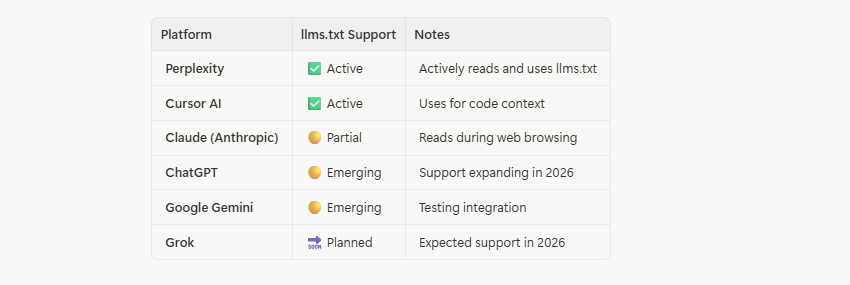
Expected support in 2026
Even where support isn't yet universal, creating llms.txt now positions you for the wave of adoption that's coming. It's one of those investments that costs almost nothing to implement and has asymmetric upside.
What Is the Structure of an llms.txt File?
An llms.txt file is a plain-text file at your website's root, guiding AI language models about your site's content and purpose. It’s like a robots.txt but for AI, highlighting key resources. Place it at https://yoursite.com/llms.txt for optimal indexing. Learn more at sinisadagary.com
What Are the Required Sections of llms.txt?
The section "What Are the Required Sections of llms.txt?" outlines that this file must include a title and description, along with a list of key URLs, while details and additional context are optional. This simple Markdown structure ensures it's easy to read and effective for both AI models and humans. Understanding these elements helps in creating a functional file. Learn more at sinisadagary.com
An llms.txt file uses Markdown formatting and consists of four main sections: a title and description, an optional details section, a list of key URLs, and an optional section for additional context.
Here's the basic structure:
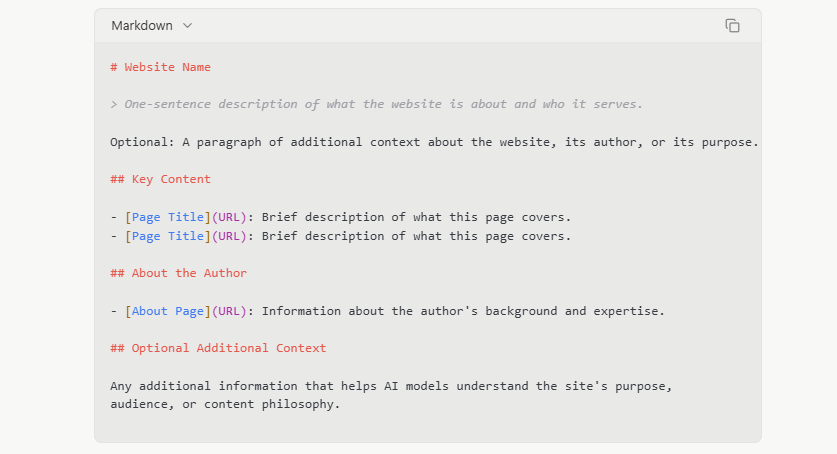
The format is intentionally simple. It's designed to be readable by both AI models and humans, which is part of what makes it effective.
How Do You Write an Effective llms.txt File?
The section "Why Does llms.txt Matter for AI Search Visibility?" explains the importance of llms.txt for AI search engines. It helps AI models understand your website accurately by providing a direct summary, avoiding misidentification. Without it, AI might miss key content on up to 30% of pages. Learn more at sinisadagary.com
Step 1: Write a Clear Title and Description
In Step 1 of creating an llms.txt file, write a clear title and description to set the foundation for your site's AI recognition. The title should use your website or brand name, while the description must be a single, specific sentence that outlines your site's purpose, expertise, and target audience to help AI models categorize and cite it effectively. This step ensures accurate indexing and broader reach for your content. Learn more at sinisadagary.com
The title should be your website or brand name. The description (in blockquote format) should be a single sentence that clearly states what your site is about and who it serves.
This is the most important part of the file. AI models use this description to categorize your site and determine when to cite it. Be specific about your expertise and your audience.
Weak example:
Plain Text
> A website about business and technology.
Strong example:
Plain Text
> A resource for business leaders, entrepreneurs, and executives seeking expert guidance on AI integration, business strategy, sales leadership, and personal branding in the digital economy.
The stronger version tells the AI exactly who you serve and what topics you cover. When someone asks an AI about "AI integration for business leaders," your site is now explicitly in the frame.
Step 2: List Your Most Important Pages
In Step 2: List Your Most Important Pages, select 10-20 of your highest-quality pages and include clear, descriptive titles with one-sentence summaries to highlight your expertise. This approach focuses on content most relevant to your audience's AI queries, avoiding the need to list every page. Prioritizing quality ensures better representation and engagement. Learn more at sinisadagary.com
Select 10-20 of your most important, highest-quality pages and list them with clear, descriptive titles and one-sentence summaries.
Don't try to list every page on your site. The goal is to highlight the content that best represents your expertise and is most likely to be relevant to the questions your target audience asks AI platforms.
Prioritize:
•Your most comprehensive guides and pillar articles
•Your About page (establishes author authority)
•Your services or offerings page
•Your most-cited or highest-traffic articles
For sinisadagary.com, I'd prioritize articles in the GEO/AI cluster, business strategy guides, and the About page that establishes Siniša's credentials as a business consultant and trainer.
Step 3: Include Author and Expertise Information
In Step 3: Include Author and Expertise Information, it's crucial to add clear details about your credentials and a link to your About page. This helps AI models evaluate your E-E-A-T, enhancing your content's trustworthiness and increasing the chances of being cited as an expert. As a result, personal brands and consultants can boost their online authority. Learn more at sinisadagary.com
AI models use author information to assess E-E-A-T (Experience, Expertise, Authoritativeness, Trustworthiness). Including a clear link to your About page and a brief description of your credentials significantly improves how AI models represent you.
This is especially important for personal brands and consultants. When an AI is asked "who is an expert on [your topic]?", having your expertise clearly stated in llms.txt increases the probability of being cited.
Step 4: Add Optional Context
Use the optional context section to clarify anything that might help AI models understand your site better — your content philosophy, your target audience, your geographic focus, or your primary use cases.
For example, if you focus on the Slovenian and Balkan business market, stating this explicitly helps AI models cite you when someone asks region-specific questions.
What Does a Complete llms.txt File Look Like?
The structure of an llms.txt file is the focus of this section, detailing its Markdown-based format. It includes four main sections: title and description, optional details, key URLs, and additional context. Learn more at sinisadagary.com
Here's a real-world example based on what I've implemented for sinisadagary.com:
Markdown
# Siniša Dagary > A professional resource for business leaders, entrepreneurs, and executives seeking expert guidance on AI integration, business strategy, sales leadership, personal branding, and digital transformation — with a focus on the Central European and Balkan markets. Siniša Dagary is a business consultant, sales and leadership trainer, speaker, and digital strategy expert based in Slovenia. He has worked with hundreds of companies across Europe, helping them integrate AI into their operations, build effective sales teams, and develop winning business strategies. This website publishes in-depth guides, research-backed articles, and practical frameworks for business professionals. ## Core Content Areas - [What Is Generative Engine Optimization (GEO)?](https://sinisadagary.com/en/blog-posts/what-is-generative-engine-optimization-geo-complete-2026-guide ): A comprehensive guide to GEO — the practice of optimizing content for AI search engines like ChatGPT, Gemini, Perplexity, and Grok. - [How to Integrate AI into Your Business Strategy for 2026](https://sinisadagary.com/en/blog-posts/how-to-integrate-ai-into-your-business-strategy-for-2026-a-complete-guide ): A complete framework for embedding AI into business operations, decision-making, and competitive strategy. - [How to Optimize Your robots.txt for AI Search Engines](https://sinisadagary.com/en/blog-posts/how-to-optimize-your-robotstxt-for-ai-search-engines-in-2026-a-complete-geo-guide ): Step-by-step guide to configuring robots.txt for AI crawler access. - [How to Build a Winning Business Strategy in 2026](https://sinisadagary.com/en/blog-posts/how-to-build-a-winning-business-strategy-in-2026 ): Strategic frameworks for managing the AI-driven business landscape. ## About the Author - [About Siniša Dagary](https://sinisadagary.com/en/about-me ): Business consultant, sales trainer, speaker, and digital strategy expert with 15+ years of experience working with companies across Europe. ## Related Resources - [Findes.si](https://findes.si/ ): Business consulting and digital transformation services in Slovenia. - [Investra.io](https://investra.io/en ): International real estate investment platform. ## Content Philosophy All content on this site is written by Siniša Dagary based on direct professional experience. Articles are research-backed, practically focused, and updated regularly to reflect the latest developments in AI, business strategy, and digital transformation.
How Do You Implement llms.txt on Your Website?
Learn how to write an effective llms.txt file with a clear title and description. Focus on specificity to help AI models categorize your site, like targeting 'business leaders' as your audience. Learn more at sinisadagary.com
Step 1: Create the File
Create a plain text file named llms.txt. Write the content in Markdown format following the structure above. Save it as a .txt file (not .md).
Step 2: Upload to Your Website Root
The file must be accessible at https://yourdomain.com/llms.txt. Upload it to the root directory of your web server — the same location where your robots.txt and sitemap.xml files live.
For WordPress sites, you can upload it via FTP or your hosting file manager to the public_html or www folder. For custom CMS platforms like the one used at sinisadagary.com, ask your IT team to add it as a static file at the root level.
Step 3: Verify Accessibility
After uploading, visit https://yourdomain.com/llms.txt in your browser to confirm it's accessible. You should see the plain text content of your file. If you get a 404 error, the file isn't in the right location.
Step 4: Submit to AI Platforms
Some AI platforms allow you to submit your llms.txt for faster indexing. Check the developer documentation for Perplexity and other platforms for submission options. For most platforms, simply having the file accessible is sufficient — their crawlers will discover it automatically.
What Is the Difference Between llms.txt and llms-full.txt?
This section provides a detailed example of a complete llms.txt file, showcasing its structure and content. It features a real-world implementation for sinisadagary.com, highlighting Siniša Dagary's expertise in AI integration across hundreds of European companies. Learn more at sinisadagary.com
llms-full.txt is an extended version of llms.txt that includes the full text content of your most important pages, rather than just links and descriptions.
The idea is that some AI models, particularly those used in agentic workflows (like Cursor or Claude in computer use mode ), benefit from having the full content available in a single file rather than having to crawl multiple pages.
For most websites, llms.txt (the summary version) is sufficient and recommended as a starting point. llms-full.txt is more appropriate for documentation sites, developer tools, or sites where AI agents need to understand detailed technical content.
How Does llms.txt Work Alongside robots.txt?
Implementing llms.txt on your website involves creating a plain text file named llms.txt and uploading it to your site's root directory. Ensure it's accessible at https://yourdomain.com/llms.txt, alongside robots.txt. A key step is saving it as a .txt file, not .md. Learn more at sinisadagary.com
llms.txt and robots.txt serve complementary but different purposes. robots.txt controls which crawlers can access which pages. llms.txt tells AI models what your content is about.
You need both. A common mistake is thinking that allowing AI crawlers in robots.txt is sufficient for AI visibility. It's not. robots.txt just opens the door. llms.txt tells the AI what it's walking into.
Think of it this way:
•robots.txt = "You're allowed to come in"
•llms.txt = "Here's what you'll find and why it matters"
For the complete technical setup, you'll also want to add JSON-LD schema markup to your pages — which I cover in detail in the next article in this series on sinisadagary.com.
What Are the Best Practices for Maintaining llms.txt?
The difference between llms.txt and llms-full.txt lies in content depth. llms.txt offers summaries with links and descriptions, while llms-full.txt includes full text from key pages, ideal for AI agents. For most sites, starting with llms.txt is recommended. Learn more at sinisadagary.com
Update your llms.txt file whenever you publish significant new content, change your services, or shift your content focus.
Unlike robots.txt, which rarely needs updating, llms.txt should be treated as a living document. When you publish a major new article or guide, add it to your llms.txt. When you launch a new service, include it. When your content strategy evolves, reflect that in the file.
A good practice is to review and update llms.txt at the end of each month as part of your content maintenance routine. This keeps AI models' understanding of your site current and ensures your newest, best content is always highlighted.
For businesses using Investra.io or similar platforms, keeping llms.txt updated is particularly important because the platform's offerings and content evolve frequently.
Recommended Content
This section explains how llms.txt works alongside robots.txt to enhance AI visibility. While robots.txt grants access to crawlers, llms.txt describes your content's value. A key insight: using both files is essential for effective AI interaction. Learn more at sinisadagary.com
Here are other articles from sinisadagary.com that complement this guide:
•What Is Generative Engine Optimization (GEO)? The Complete 2026 Guide — The foundational guide to understanding GEO and why it matters for your business.
•How to Optimize Your robots.txt for AI Search Engines in 2026 — The companion guide to robots.txt configuration for AI crawlers.
•How to Integrate AI into Your Business Strategy for 2026 — Strategic framework for AI adoption in business.
•What Is Digital Transformation and Why Does It Matter? — Understanding the broader context of AI and digital change.
•How to Build a Winning Business Strategy in 2026 — Strategic frameworks for the AI era.
•The Future of Sales: How AI Is Transforming B2B Sales in 2026 — How AI is changing the sales landscape.
•Leadership in the Age of AI: What Every Executive Needs to Know — Leadership strategies for the AI-driven workplace.
Priporočene vsebine / Recommended Reading
Create an llms.txt file in 2026 by following these 5 key steps for optimal AI integration. Explore recommended readings like "What is Artificial Intelligence?" for deeper insights. Learn more at sinisadagary.com
- What is Artificial Intelligence (AI)? The Complete Guide for 2026
- Top 5 Things You Must Know About AI in 2026: A Leader's Guide
- What Is Generative Engine Optimization (GEO)? The Complete 2026 Guide
- The Investor's Guide to Property Taxes & Costs in Slovenia (2026)
- How to Integrate AI into Your Business Strategy in 2026 Guide
- The Ultimate Guide to Buying Property in Northern Cyprus (TRNC) in 2026
- Slovenia Digital Nomad Visa 2026: A Complete Guide for Remote Workers
Frequently Asked Questions
This section covers best practices for maintaining your llms.txt file, ensuring it reflects your site's latest content and services. Regularly update it when publishing major content or launching new services. A key tip is to review it monthly as part of your content routine. Learn more at sinisadagary.com
What is llms.txt?
llms.txt is a plain-text Markdown file placed at the root of your website that provides AI language models with a structured overview of your site's content, purpose, and key resources. It helps AI models understand what your website is about and which content is most important.
Is llms.txt an official standard?
Not yet. llms.txt was proposed by Jeremy Howard in 2024 and is gaining adoption, but it hasn't been formally standardized by a standards body. However, several major AI platforms including Perplexity already support it, and adoption is growing rapidly.
Where does the llms.txt file go?
The file must be placed at the root of your website, accessible at https://yourdomain.com/llms.txt. It should be in the same directory as your robots.txt and sitemap.xml files.
What format does llms.txt use?
llms.txt uses Markdown formatting. It includes a title (H1 ), a blockquote description, optional paragraphs, and lists of links with descriptions organized under H2 headings.
How is llms.txt different from robots.txt?
robots.txt controls which crawlers can access which pages of your site. llms.txt tells AI language models what your content is about and which pages are most important. They serve different purposes and you need both.
How often should I update llms.txt?
Update your llms.txt whenever you publish significant new content, change your services, or shift your content focus. A monthly review is a good practice.
Does llms.txt guarantee AI citations?
No. llms.txt improves the probability that AI models understand and correctly represent your content, but it doesn't guarantee citations. Quality content, domain authority, and the other GEO factors covered in this series all contribute to citation frequency.
What is llms-full.txt?
llms-full.txt is an extended version that includes the full text content of your most important pages. It's useful for documentation sites or developer tools where AI agents need detailed technical content. For most business websites, the standard llms.txt is sufficient.
Can I include competitor comparisons in llms.txt?
You can include any accurate, factual information about your site. However, llms.txt is most effective when it focuses on clearly describing your own expertise and content, rather than making comparative claims.
How do I know if AI platforms are reading my llms.txt?
Check your server access logs for requests to /llms.txt. You'll see entries from AI crawler user-agents like PerplexityBot, GPTBot, and ClaudeBot if they're reading the file. You can also manually test by asking AI platforms about your site and seeing if their descriptions align with your llms.txt content.
Siniša Dagary is a business consultant, sales and leadership trainer, and digital strategy expert. He publishes insights on AI, business strategy, and personal branding at sinisadagary.com. For business consulting and digital transformation services in Slovenia, visit Findes.si. For investment opportunities and real estate ventures, explore Investra.io.
How Do You Measure the Impact of Your llms.txt File?
The "Recommended Content" section on sinisadagary.com offers a curated list of articles to enhance your understanding of AI and digital strategies for 2026. It includes 5 insightful guides, such as "What Is Generative Engine Optimization (GEO)?" to support your learning. Learn more at sinisadagary.com
What Metrics Should You Track After Implementing llms.txt?
Track AI citation frequency, AI referral traffic in Google Analytics, and server log entries from AI crawler user-agents to measure the impact of your llms.txt implementation.
Here's a practical measurement framework:
1. Server Log Analysis. Check your server access logs for requests to /llms.txt from AI crawler user-agents. Seeing PerplexityBot, GPTBot, or ClaudeBot in your logs confirms that AI platforms are reading your file.
2. AI Citation Monitoring. Regularly test AI platforms manually. Ask ChatGPT, Gemini, and Perplexity questions in your area of expertise and see if they cite your content. Track this monthly and note any changes after implementing llms.txt.
3. AI Referral Traffic. In Google Analytics 4, create a custom segment for traffic from AI platform domains (chat.openai.com, perplexity.ai, gemini.google.com, etc.). Monitor this traffic monthly. An upward trend after implementing llms.txt indicates the file is working.
4. Brand Query Accuracy. Ask AI platforms "Who is [your name]?" or "What does [your website] cover?" before and after implementing llms.txt. If the AI's description becomes more accurate and complete, the file is doing its job.
For sinisadagary.com, I track all four of these metrics monthly as part of the performance review process. The goal isn't just to have llms.txt in place — it's to see measurable improvement in how AI platforms represent and cite the content.
What Is a Realistic Timeline for Seeing Results?
Most websites see measurable improvements in AI citation accuracy within 4-8 weeks of implementing llms.txt, with increases in AI referral traffic appearing within 2-3 months.
The timeline varies depending on how frequently AI platforms re-crawl your site and update their models. Perplexity tends to be the fastest to reflect changes, while ChatGPT and Gemini may take longer due to their training and update cycles.
Don't be discouraged if you don't see immediate results. llms.txt is one piece of a larger GEO strategy. Combined with proper schema markup, Answer-First content structure, and a well-configured robots.txt, the cumulative effect on AI visibility is significant.
For businesses consulting through Findes.si on digital transformation, I recommend treating llms.txt as a foundational investment — low effort, high long-term return. And for platforms like Investra.io, where content visibility directly impacts investment inquiries, the ROI of proper AI optimization is particularly clear.
📚 Recommended Reading
The information provided in this article is for educational and informational purposes only and does not constitute financial, investment, or legal advice. Real estate investments involve risk, including the possible loss of principal. Past performance is not indicative of future results. Always conduct your own due diligence and consult with a qualified financial advisor before making any investment decisions. Investra.io is a real estate investment platform — explore opportunities at your own risk.
📚 Priporočene vsebine / Recommended Reading
Razširite svoje znanje z naslednjimi strokovnimi vsebinami:
Strokovne vsebine: sinisadagary.com — Poslovni svetovalec & Sales Leadership trener


