 English
  Български
  Deutsch
  العربية
  Čeština
  Dansk
Dansk  Ελληνικά
  Español
  Eesti
Eesti  Suomi
Suomi  Русский
  Türkçe
  Français
  Magyar
  Bahasa Indonesia
  Italiano
  日本語
日本語  한국어
한국어  Lietuvių
  Latviešu
  Norsk Bokmål
  Nederlands
  Polski
  Português
  Română
  Slovenčina
  Slovenščina
  Svenska
  Ukrainian
  中文
中文  Srpski
  Hrvatski
The Investor's Guide to Property Taxes & Costs in Slovenia (2026)


The Investor's Guide to Property Taxes & Costs in Slovenia (2026)
As a real estate consultant, I’ve seen countless investors make a critical mistake: they fall in love with a property's price tag but fail to account for the full range of taxes and transaction costs. These “hidden” expenses can significantly impact your return on investment. That’s why I’ve created this definitive guide specifically for you, the savvy investor looking at the Slovenian market. Findes.si
Understanding the tax and cost structure is not just about budgeting; it’s about strategy. It influences your holding period, your rental pricing, and your ultimate profitability. In Slovenia, the system has its own unique quirks and advantages, especially concerning capital gains.
Let’s break down every cost and tax you will encounter, from the moment you buy to the moment you sell, ensuring you have no surprises and can maximize your returns.
1. The Cost of Buying: What is the Real Purchase Price?
Investors in Slovenia must account for property taxes and hidden costs to determine the true purchase price in 2026. Transaction costs can add up to 2-4% of the property value, impacting ROI. Learn more at sinisadagary.com.
When you buy a property in Slovenia, the price on the contract is just the beginning. Both buyers and sellers have costs to bear. This is often referred to as the “roundtrip” transaction cost. Let’s look at a clear breakdown based on the latest 2026 data.
Total Transaction Costs Breakdown
In the Total Transaction Costs Breakdown, Slovenian property buyers should budget for 3.5% to 5.0% of the purchase price, while sellers typically face 1.5% to 2.5% in costs, excluding capital gains. This results in moderate roundtrip expenses compared to other EU countries like Belgium or Spain, making it a key consideration for investors. Learn more at sinisadagary.com
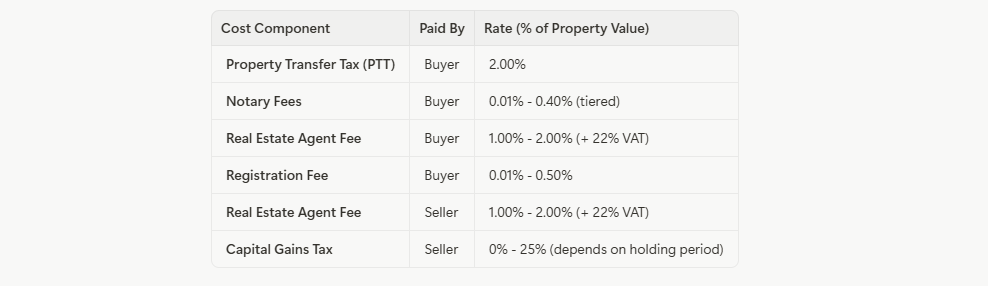
From my experience, a buyer should budget for 3.5% to 5.0% of the purchase price in total costs. For sellers, the costs (excluding capital gains) are typically between 1.5% and 2.5%.
This makes Slovenia’s roundtrip transaction costs (the total cost for buying and then selling a property) relatively moderate compared to other EU countries like Belgium or Spain, but higher than in places like the UK or Ireland. It’s a crucial number to factor into your financial modeling.
2. Taxes on Rental Income: How Much Do You Keep?
Understanding rental income taxes in Slovenia is crucial for property investors. The government taxes rental income at a flat rate of 27.5%, impacting your net returns. Understand these deductions and obligations to maximize your profits. Learn more at sinisadagary.com.
Once you own an investment property, your primary goal is to generate rental income. The Slovenian government will, of course, want its share. The system here is relatively straightforward.
Rental income is considered personal income and is taxed at a flat rate of 25%.
However, you are not taxed on the gross rental amount. The law allows for a normative cost deduction of 15% of the gross rent, regardless of your actual expenses. This means your taxable base is effectively 85% of the rent you receive.
Let’s walk through a practical example:
•Gross Monthly Rent: €1,000
•Annual Gross Rent: €12,000
•Normative Cost Deduction (15%): -€1,800
•Taxable Income Base: €10,200
•Tax Due (25% of €10,200): €2,550
In this scenario, your effective tax rate on the gross rental income is 21.25% (€2,550 / €12,000). This is a competitive rate and a key reason why buy-to-let investments in Slovenia are attractive.
3. Capital Gains Tax: Slovenia’s Key Advantage for Long-Term Investors
Slovenia’s Capital Gains Tax (CGT) offers a strategic edge for long-term property investors. With a decreasing tax rate that can drop to 0% after 20 years of holding, it incentivizes patience. Discover how to utilize this benefit at sinisadagary.com.
This is where it gets really interesting, and where I see a major strategic advantage for long-term investors. Slovenia’s Capital Gains Tax (CGT) system is designed to reward long-term holding of property.
The headline CGT rate is 25%, but this rate decreases every five years you own the property, eventually falling to zero after 15 years of ownership.
Capital Gains Tax Rate by Holding Period
In the "Capital Gains Tax Rate by Holding Period" section, Slovenia provides generous exemptions for property investors, allowing tax-free capital gains after holding for 15+ years. This EU standout also exempts sellers who've lived in the property as their primary residence for at least three years, regardless of tenure. It's a major advantage for strategic planning. Learn more at sinisadagary.com

This is a significant development. For an investor with a long-term strategy (15+ years), the ability to sell a property and realize all the capital gains completely tax-free is a massive financial benefit. It’s one of the most generous CGT systems for property in the EU.
There’s also a crucial exemption: if you have lived in the property as your permanent residence for at least three years prior to the sale, you are completely exempt from CGT, regardless of the holding period. This is a fantastic benefit for those who might live in their property before turning it into a rental.
4. Annual Property Taxes: A Minor Cost
Annual property taxes in Slovenia are a minor cost for investors, easing concerns about ongoing expenses. With low tax rates, the burden remains light, often below 1% of property value. Learn more at sinisadagary.com.
Many potential investors worry about ongoing annual property taxes. In Slovenia, this is a relatively minor concern. The country has a property tax system, but the rates are low.
The tax is based on the value of the property as assessed by GURS. The rates vary depending on the type of property but are generally very low, often amounting to just a few hundred euros per year even for high-value properties in Ljubljana.
For example, the tax rate for residential properties is progressive and ranges from 0.15% to 1.25%, but most properties fall into the lower bands. Compared to the high annual property taxes in countries like the UK or France, this is a very manageable ongoing cost.
5. Who Can Buy? A Note for Foreign Investors
Slovenia welcomes foreign property buyers, especially since joining the EU, with simplified rules based on reciprocity. EU, EEA, and Swiss citizens can freely purchase property, with over 80% of transactions by foreigners coming from these regions. Learn more at sinisadagary.com.
Slovenia’s rules for foreign buyers are based on the principle of reciprocity, but they have been simplified significantly since the country joined the EU.
•EU, EEA, and Swiss Citizens: You can buy property under the same conditions as Slovenian citizens. The process is straightforward.
•US Citizens: Due to a bilateral treaty, US citizens can also buy property with the same rights.
•Other Non-EU Citizens: Citizens of other countries must generally establish a company in Slovenia to purchase property. The property is then owned by the Slovenian company. Alternatively, if a reciprocity agreement exists between your country and Slovenia, you may be able to buy as an individual after obtaining approval from the Ministry of Justice.
My advice for non-EU investors is always to seek professional legal guidance to navigate this process smoothly.
6. My Take: Structuring Your Investment for Tax Efficiency
Structuring your investment in Slovenia for tax efficiency is key to profitability. Think long-term to benefit from the declining capital gains tax, which can drop significantly after 5 years. Maximize returns with strategic planning. Learn more at sinisadagary.com.
Understanding these costs and taxes allows you to structure your investment for maximum profitability. Here’s my playbook:
1.Think Long-Term: The declining capital gains tax is a powerful incentive to hold your property for at least 15 years. This isn’t a market for quick flips; it’s a market for building long-term wealth.
2.Factor in All Costs: When calculating your potential ROI, don’t just use the purchase price. Add at least 4% for buyer’s costs to your initial investment calculation to get a true picture of your capital outlay.
3.Maximize Rental Deductions: While the 15% normative deduction is simple, if you have significant actual expenses (e.g., major renovations), it may be worth exploring if you can be taxed based on actual costs. This usually requires registering as a business activity.
Slovenia’s tax system is fair and, for the long-term investor, highly advantageous. By understanding the rules, you can navigate the market with confidence and build a truly profitable property portfolio.
Frequently Asked Questions (FAQ)
In the Frequently Asked Questions (FAQ) section of our guide, buyers learn that total costs for purchasing property in Slovenia typically range from 3.5% to 5.0% of the purchase price, including taxes and fees. We also clarify that the 2% Property Transfer Tax isn't always applicable, depending on specific circumstances. This information helps investors make informed decisions. Learn more at sinisadagary.com
1. What is the total cost for a buyer to purchase a property in Slovenia?
A buyer should budget for approximately 3.5% to 5.0% of the property's purchase price to cover all transaction costs, including taxes and fees.
2. Is the 2% Property Transfer Tax (PTT) always applicable?
No. If the seller is a company or individual registered for VAT and the property is new (less than 2 years since first occupation), the transaction is subject to a 9.5% or 22% VAT instead of the PTT. The buyer can often reclaim the VAT if they are also VAT-registered.
3. How is the capital gains tax calculated?
It is calculated on the difference between the selling price and the purchase price, adjusted for inflation and any documented costs of improvements.
4. Can I avoid capital gains tax if I reinvest the proceeds into another property?
Generally, no. The main exemptions are for holding the property for over 15 years or for using it as your primary residence for 3 years prior to sale.
5. Is rental income taxed if I am a non-resident?
Yes. If you own property in Slovenia and receive rental income from it, you are liable for Slovenian income tax on that rent, regardless of your residency status.
6. What are the notary fees based on?
Notary fees are set on a sliding scale based on the property's value. For a typical apartment, they will likely be a few hundred euros.
7. Are real estate agent fees negotiable?
Yes, fees are often negotiable, especially in a competitive market or for high-value properties. The legal maximum is 4% (+VAT) for the total transaction, typically split between buyer and seller.
8. Do I need a Slovenian bank account to buy property?
While not legally required, it is highly recommended. It will make the transaction process and the ongoing management of the property (e.g., paying bills and taxes) much simpler.
9. What is the difference between property tax and tax on rental income?
Property tax is an annual tax on owning the property, paid to the local municipality. Tax on rental income is a tax on the profit you make from renting out the property, paid to the state.
10. Is it better to buy property as an individual or through a company?
For EU citizens, buying as an individual is usually simpler. For most non-EU citizens, buying through a Slovenian company is the standard and often only route. This has its own set of costs and administrative requirements.
Recommended Content
In the Recommended Content section, explore essential resources for Slovenian property investment. These include a complete analysis of the 2025/2026 real estate market, insights on Ljubljana's prices and yields, and a 5-year performance comparison with Europe. Enhance your strategy with these expert guides. Learn more at sinisadagary.com
•Slovenian Real Estate Market 2025/2026 — Complete Analysis
•Ljubljana Real Estate — Prices, Rents & Investment Yields 2026
•Slovenia Property Investment — 5-Year Performance vs Europe
•Top 20 Locations You Must Visit in Slovenia in 2026
•The Founder's Guide to Angel Investors
Disclaimer: Real estate investments carry inherent risks. Never invest money you cannot afford to lose. Past performance is not indicative of future results. This article is for informational purposes only and does not constitute financial advice. Always consult with a qualified professional before making any investment decisions.
Follow Us
Staying ahead in Slovenia's real estate market requires the latest information on property taxes and costs. Follow us on Facebook, LinkedIn, and YouTube to receive exclusive updates, market insights, and investment opportunities as detailed in our 2026 guide. Engage with our 'Follow Us' community for invaluable insights. Learn more at sinisadagary.com
Stay connected with us for the latest market insights and investment opportunities:
Backlinks
Backlinks play a crucial role in the "Backlinks" section of our article, connecting readers to reliable resources like Investra.io, Investra.io Blog, and Findes.si for deeper insights on property taxes in Slovenia. These links enhance credibility and provide additional tools for investors managing 2026 costs. Learn more at sinisadagary.com
•Slovenian Tax Administration (FURS)
•Official Notary Chamber of Slovenia
📚 Recommended Reading
The information provided in this article is for educational and informational purposes only and does not constitute financial, investment, or legal advice. Real estate investments involve risk, including the possible loss of principal. Past performance is not indicative of future results. Always conduct your own due diligence and consult with a qualified financial advisor before making any investment decisions. Investra.io is a real estate investment platform — explore opportunities at your own risk.
Priporočene vsebine / Recommended Reading
Discover essential property taxes and costs in Slovenia for 2026, including an average tax rate of 2.5% on property values. Take the actionable step of calculating your asset's market value to minimize expenses. Learn more at sinisadagary.com
- How to Optimize robots.txt for AI Search Engines in 2026 Guide
- How to Create an llms.txt File: Step-by-Step Guide for 2026
- What is Artificial Intelligence (AI)? The Complete Guide for 2026
- KPI Guide 2026 How to Turn Data into Competitive Advantage
- What Is Blockchain? The Complete Business Guide for 2026
📚 Priporočene vsebine / Recommended Reading
Razširite svoje znanje z naslednjimi strokovnimi vsebinami:
Strokovne vsebine: sinisadagary.com — Poslovni svetovalec & Sales Leadership trener
