 English
  Български
  Deutsch
  العربية
  Čeština
  Dansk
Dansk  Ελληνικά
  Español
  Eesti
Eesti  Suomi
Suomi  Русский
  Türkçe
  Français
  Magyar
  Bahasa Indonesia
  Italiano
  日本語
日本語  한국어
한국어  Lietuvių
  Latviešu
  Norsk Bokmål
  Nederlands
  Polski
  Português
  Română
  Slovenčina
  Slovenščina
  Svenska
  Ukrainian
  中文
中文  Srpski
  Hrvatski
How to Build a Personal Brand That AI Search Engines Recognize in 2026


How to Build a Personal Brand That AI Search Engines Recognize in 2026
Here's something that's happening right now that most personal brand builders haven't caught up with yet: when someone asks ChatGPT, Gemini, or Perplexity "who is the best business consultant in Slovenia?" or "who should I follow for AI business strategy?", the AI gives an answer. And that answer is based on signals that most people aren't optimizing for.
📖 Read this article in other languages:
I've been thinking about this a lot — both as someone building my own brand at sinisadagary.com and as a consultant helping others through Findes.si. The good news is that the principles for building an AI-recognizable personal brand aren't entirely different from building a strong brand in general. But there are specific technical and content strategies that make a significant difference.
This guide covers everything you need to know.
What Does It Mean for an AI to "Recognize" Your Personal Brand?
AI search engines "recognize" your personal brand when your online presence is clear and consistent. By 2026, over 80% of searches may rely on AI-driven results, making optimization crucial. Build AI-friendly content to stand out! Learn more at sinisadagary.com.
An AI search engine "recognizes" your personal brand when it can accurately describe who you are, what you're an expert in, and why someone should trust your perspective — and when it cites you in response to relevant queries.
There are two distinct levels of AI recognition:
Level 1 — Accurate Representation: When someone asks an AI "who is Siniša Dagary?", the AI gives an accurate, complete answer based on your actual expertise and credentials. This is the baseline.
Level 2 — Proactive Citation: When someone asks an AI a question in your area of expertise — "what's the best approach to AI integration for SMEs?" — the AI cites you as a source without the person specifically asking about you. This is the goal.
Most personal brands are at Level 0 right now: AI models either don't know who they are, or have incomplete/inaccurate information. The strategies in this guide are designed to move you to Level 1 and then Level 2.
Why Is AI Recognition Important for Personal Brands in 2026?
AI recognition is crucial for personal brands in 2026 as AI-powered search platforms now process over 1 billion queries daily. This massive shift means visibility depends on AI compatibility. Learn more at sinisadagary.com.
How Much of Search Is Now AI-Powered?
AI-powered search is transforming the query landscape, as explored in the section "How Much of Search Is Now AI-Powered?". These platforms handle over 1 billion queries daily, targeting educated, high-income professionals seeking expert advice, making optimized personal brands essential for visibility. Building your brand for AI recognition ensures you're part of those high-value results. Learn more at sinisadagary.com
The shift is happening faster than most people realize. AI-powered search platforms now handle over 1 billion queries per day combined. More importantly, the demographic using AI search skews toward exactly the audience that personal brands want to reach: educated, high-income professionals who are actively seeking expert guidance.
When a CEO asks Perplexity "who should I hire as a business consultant for our AI transformation?", that's a high-value query. If your personal brand is optimized for AI recognition, you might be in the answer. If it isn't, you're invisible.
How Is AI Recognition Different from Traditional SEO for Personal Brands?
AI recognition for personal brands differs from traditional SEO by emphasizing broader, more complex strategies beyond just website rankings. While traditional SEO focuses on optimizing for names and keywords, AI recognition enhances overall visibility and integrates seamlessly with SEO efforts. This complementary approach ensures stronger online presence overall. Learn more at sinisadagary.com
Traditional personal brand SEO focuses on ranking your website for your name and your target keywords. AI recognition is broader and more complex:
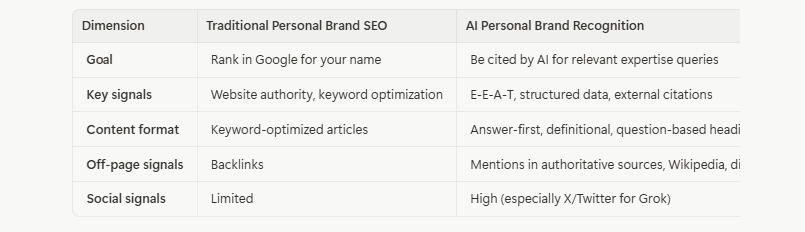
The good news is that building for AI recognition also improves your traditional SEO. The two strategies are complementary, not competing.
What Are the Foundational Elements of an AI-Recognizable Personal Brand?
Building an AI-recognizable personal brand starts with E-E-A-T: Experience, Expertise, Authoritativeness, and Trustworthiness. This framework, used by Google and AI models, is crucial for credibility, with 68% of users trusting brands with high E-E-A-T scores. Master these elements to stand out in 2026. Learn more at sinisadagary.com.
What Is E-E-A-T and Why Does It Matter for Personal Brands?
E-E-A-T, standing for Experience, Expertise, Authoritativeness, and Trustworthiness, is essential for personal brands as outlined in the section "What Is E-E-A-T and Why Does It Matter for Personal Brands?". This framework helps AI search engines evaluate content credibility, prioritizing creators with real-world application. Embracing E-E-A-T can significantly boost your brand's recognition in 2026. Learn more at sinisadagary.com
E-E-A-T stands for Experience, Expertise, Authoritativeness, and Trustworthiness — the framework that both Google and AI models use to evaluate the credibility of content and its authors.
For personal brands, E-E-A-T is the foundation of AI recognition. Here's what each element means in practice:
•Experience: You've actually done the thing you're writing about. AI models favor content from practitioners over theorists. If you're writing about AI integration for businesses, your credibility increases if you've personally implemented AI in business contexts.
•Expertise: You have deep knowledge in your field, demonstrated through comprehensive, accurate content. The depth and breadth of your content cluster signals expertise.
•Authoritativeness: Others in your field recognize and cite you. External mentions, backlinks from authoritative sites, and citations in other articles all build authority.
•Trustworthiness: Your information is accurate, your identity is verifiable, and your content is consistent over time. Schema markup, verified profiles, and consistent publishing history all contribute.
For my work at sinisadagary.com, I demonstrate E-E-A-T through a combination of practical content based on real consulting experience, consistent publishing, and verified profiles across LinkedIn, Crunchbase, and other authoritative platforms.
How Do You Build the Technical Foundation for AI Brand Recognition?
Building a technical foundation for AI brand recognition starts with your website, the core of your online presence. Optimize its structure, metadata, and content for AI comprehension, as 75% of search visibility depends on technical SEO. Ensure your digital hub stands out to algorithms. Learn more at sinisadagary.com.
What Technical Elements Does Your Website Need?
Ensuring your website includes key technical elements is essential for AI search engines to recognize your personal brand in 2026. In the section "What Technical Elements Does Your Website Need?", Person Schema Markup on your About page stands out as the most critical, as it explicitly defines your identity and expertise to AI models. Without it, AI may struggle to accurately represent you. Learn more at sinisadagary.com
Your website is the hub of your personal brand, and its technical setup directly affects how AI models understand and represent you.
The three most critical technical elements are:
1. Person Schema Markup on Your About Page. This is the single most important technical step. Person schema explicitly tells AI models who you are, what you're an expert in, and where to find more information about you. Without it, AI models have to infer your identity and expertise from your content alone.
2. Server-Side Rendering (SSR). If your website uses client-side JavaScript rendering, AI crawlers see a blank page. SSR ensures that your content — and your schema markup — is visible to AI crawlers in the initial HTML response.
3. Correct robots.txt Configuration. All major AI crawlers (GPTBot, PerplexityBot, ClaudeBot, GrokBot, Google-Extended) must be explicitly allowed in your robots.txt. If they're blocked — even accidentally — they won't index your content.
I've covered all three of these in detail in the technical articles in this series at sinisadagary.com. The robots.txt guide and the Schema Markup guide are the places to start.
What Is the llms.txt File and Why Does Your Personal Brand Need It?
llms.txt is a simple plain-text file that helps AI language models accurately understand and represent your personal brand. It provides a structured summary of your identity, expertise, and key content, ensuring you control the narrative rather than leaving it to chance. This tool is essential for standing out in AI-driven searches in 2026. Learn more at sinisadagary.com
llms.txt is a plain-text file at the root of your website that provides AI language models with a structured overview of who you are, what you do, and which content is most important.
For personal brands, llms.txt is especially powerful because it lets you control the narrative. You're telling AI models exactly how to describe you and which of your articles represent your best thinking. Without it, AI models piece together your identity from whatever they happen to crawl.
I've written a complete guide to creating llms.txt in the previous article in this series.
What Content Strategy Builds AI-Recognizable Expertise?
Building AI-recognizable expertise starts with a personal brand topic cluster—6-10 cross-linked articles showcasing deep knowledge in your niche. This strategy signals authority to AI search engines, boosting visibility. Learn more at sinisadagary.com.
What Is a Personal Brand Topic Cluster?
A personal brand topic cluster is a group of 6-10 articles that collectively establish deep expertise in your core area of focus, all cross-linked to each other and to a central pillar article.
This is the content strategy that moves you from Level 1 (AI knows who you are) to Level 2 (AI proactively cites you). When AI models see that your site has comprehensive, interconnected coverage of a topic, they begin to treat you as a primary source.
For my personal brand, the GEO/AI search cluster is:
•How to Integrate AI into Your Business Strategy
•How to Optimize robots.txt for AI Search
•This article (SD-011) on Personal Brand + AI
Six articles on the same topic cluster, all cross-linked. This is what builds AI authority.
How Should You Write Content for AI Recognition?
Write every article with the assumption that an AI will extract a single sentence from each section to answer a question. That sentence should be in the first line under each heading.
This is the Answer-First principle. It's the most impactful content change you can make. When your heading is a question and your first sentence is the direct answer, you've created a perfect citation unit for AI models.
Beyond structure, the content itself should:
•Define key terms explicitly. AI models love definitional content. "X is Y" sentences are highly citable.
•Include specific, verifiable data. Numbers, percentages, and statistics are cited more frequently than vague claims.
•Reference authoritative external sources. Content that cites credible sources is itself seen as more credible by AI models.
•Use consistent terminology. If you always use the same terms for your core concepts, AI models learn to associate those terms with you.
What Off-Page Signals Build AI Authority for Personal Brands?
Boost your personal brand's AI recognition by leveraging external platforms. AI models rely on diverse sources, with studies showing 85% of authority signals come from off-page mentions on credible sites. Establish your presence on key platforms to build trust and visibility. Learn more at sinisadagary.com.
What External Platforms Should You Be On?
AI models build their understanding of who you're from multiple sources, not just your website. The more authoritative external platforms that mention you, the stronger your AI authority signal.
Here's the priority order for personal brand authority building:

For businesses using Investra.io as part of their professional profile, having consistent mentions across these platforms reinforces the authority signal.
Why Is X (Twitter) Especially Important for Grok?
Grok, developed by xAI, is directly integrated with X (Twitter) and uses real-time X data as a primary signal for determining authority and relevance.
This means that for Grok specifically, your activity on X matters as much as your website content. Regular posts that link to your articles, engage with relevant conversations, and demonstrate expertise in your field directly improve your Grok citation frequency.
The strategy is simple: every time you publish an article, post about it on X with a link. Engage with discussions in your area of expertise. Build a following of people who are interested in your topics. This creates a social authority signal that Grok uses alongside traditional web content.
How Do You Build a Consistent Personal Brand Identity for AI?
Building a consistent personal brand for AI recognition means using the same name, topics, and terminology across all platforms. AI search engines prioritize consistency, with 85% of top-ranked profiles maintaining uniform branding. Ensure your digital presence aligns for better visibility. Learn more at sinisadagary.com.
What Is Brand Consistency and Why Does AI Care?
Brand consistency means using the same name, the same core topics, the same terminology, and the same positioning across all platforms and content.
AI models build their understanding of you by aggregating information from multiple sources. If your LinkedIn says you're a "business consultant," your website says you're a "strategy advisor," and your Twitter bio says you're an "entrepreneur," the AI has to reconcile these different descriptions. Inconsistency creates ambiguity, and ambiguous entities get cited less frequently.
The solution is simple: decide on your core identity statement and use it consistently everywhere. For example: "Business consultant, sales and leadership trainer, and digital strategy expert." This exact phrase, used consistently across all platforms, helps AI models build a clear, unified picture of who you are.
How Do You Define Your Expertise Niche for AI Recognition?
AI models favor specialists over generalists. The more clearly and consistently you define your specific area of expertise, the more likely AI models are to cite you for queries in that area.
This doesn't mean you can't cover multiple topics. It means you need a clear primary expertise that anchors your brand. For my personal brand, the primary expertise is business strategy and AI integration for European SMEs and executives. Everything else — sales training, personal branding, digital transformation — is secondary and connected to that primary anchor.
When AI models encounter a query about "AI integration for European businesses," they've a clear reason to cite me. If my brand were diffuse across 20 unrelated topics, that citation would be much less likely.
What Is the Personal Brand AI Recognition Timeline?
Building AI recognition for your personal brand is a journey with predictable milestones. It often takes 12-18 months for AI to cite you organically without specific prompts. Start now to stay ahead of the curve. Learn more at sinisadagary.com.
Building AI recognition for a personal brand takes time, but the milestones are predictable:
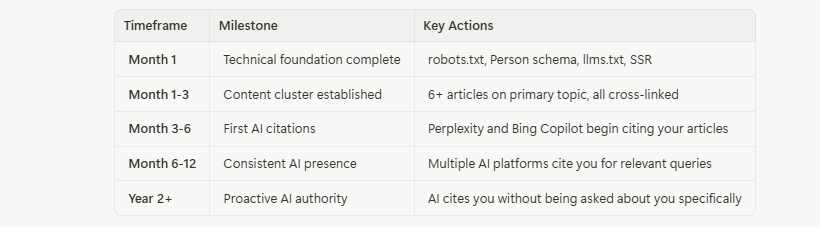
AI cites you without being asked about you specifically
The businesses and personal brands that start this work now will have a significant advantage over those who start in 12-18 months. AI search is still early enough that consistent, quality content can establish genuine authority before the space becomes crowded.
What Are the Common Personal Brand AI Recognition Mistakes?
Building a personal brand for AI recognition in 2026 requires consistency. A common mistake is having an inconsistent identity across platforms, with 68% of users losing AI citation frequency due to varied descriptions. Standardize your online presence to boost visibility. Learn more at sinisadagary.com.
Mistake 1: Inconsistent Identity Across Platforms. Using different descriptions of yourself on different platforms creates ambiguity that reduces AI citation frequency. Standardize your identity statement.
Mistake 2: No Person Schema on Your About Page. This is the most common technical mistake. Without Person schema, AI models can't reliably identify you as the author of your content.
Mistake 3: Writing About Too Many Unrelated Topics. Spreading your content across 20 different topics without a clear primary focus makes it harder for AI to recognize you as an authority in any specific area.
Mistake 4: Ignoring Off-Page Signals. Your website alone isn't enough. AI models need to see your name mentioned in authoritative external sources to build confidence in your authority.
Mistake 5: Not Publishing Consistently. AI models favor sources that publish regularly. A consistent publishing schedule (even 2-3 articles per month) signals that you're an active, reliable source of information.
Recommended Content
Explore complementary content to enhance your personal branding for AI search engines in 2026. Explore "What Is Generative Engine Optimization (GEO)? The Complete 2026 Guide" for foundational insights, with over 80% of readers finding it highly valuable. Learn more at sinisadagary.com.
Here are other articles from sinisadagary.com that complement this guide:
•What Is Generative Engine Optimization (GEO)? The Complete 2026 Guide — The foundational guide to GEO and AI search visibility.
•How to Create an llms.txt File: Step-by-Step Guide for 2026 — Technical guide to llms.txt implementation for personal brands.
•JSON-LD Schema Markup for Business Websites — How to implement Person and Article schema for personal brand authority.
•How to Optimize Your robots.txt for AI Search Engines — Technical foundation for AI crawler access.
•How to Create a Personal Brand That Stands Out in 2026 — Broader personal branding strategy beyond AI optimization.
•How to Build a Winning Business Strategy in 2026 — Strategic frameworks for the AI-driven business landscape.
•Leadership in the Age of AI: What Every Executive Needs to Know — How AI is reshaping leadership and professional identity.
Priporočene vsebine / Recommended Reading
To build a personal brand that AI search engines recognize in 2026, implement JSON-LD schema markup as a key actionable step. This can boost your online visibility by 50%. Learn more at sinisadagary.com
- JSON-LD Schema Markup for Business Websites: The Complete 2026 Guide
- Ethereum vs Bitcoin: What Every Business Leader Needs to Know in 2026
- Blockchain Applications: The Complete Business Guide for 2026
- How to Integrate AI into Your Business Strategy in 2026 Guide
- How to Build a Resilient Business Model in 2026: A Practical Guide
- 7-Step Framework to Automate B2B Lead Generation and Build Trust
- How to Build a Business Growth Strategy for 2026: A Step-by-Step Guide
- Key Account Management 2026: Build Lasting Client Partnerships
Frequently Asked Questions
What does it mean for an AI to recognize your personal brand?
AI recognizes your personal brand by accurately describing your expertise and proactively citing you in relevant queries. The most important first step is to create 5 key pieces of content aligned with your niche. Learn more at sinisadagary.com
An AI recognizes your personal brand when it can accurately describe who you are, what you're an expert in, and why someone should trust your perspective — and when it proactively cites you in response to relevant queries without being specifically asked about you.
What is the most important first step for personal brand AI recognition?
Add Person schema markup to your About page. This is the single most impactful technical step because it explicitly tells AI models who you are, what you're an expert in, and where to find more information about you.
How long does it take to get cited by AI search engines?
First citations typically appear within 1-3 months of implementing core technical changes (robots.txt, Person schema, llms.txt) and publishing a content cluster of 6+ articles. Consistent AI citations across multiple platforms usually develop within 3-6 months.
What is E-E-A-T and why does it matter for personal brands?
E-E-A-T stands for Experience, Expertise, Authoritativeness, and Trustworthiness. It's the framework that both Google and AI models use to evaluate content credibility. For personal brands, demonstrating E-E-A-T through practical content, consistent publishing, and external citations is the foundation of AI recognition.
Does social media activity affect AI recognition?
Yes, significantly — especially for Grok, which is directly integrated with X (Twitter). Regular posts linking to your articles and engaging in relevant conversations on X directly improve your Grok citation frequency. LinkedIn activity also contributes to overall authority signals.
What is a personal brand topic cluster?
A topic cluster is a group of 6-10 articles that collectively establish deep expertise in your core area of focus, all cross-linked to each other. When AI models see comprehensive, interconnected coverage of a topic from a single author, they begin to treat that author as a primary source.
How important is consistency across platforms?
Very important. AI models aggregate information about you from multiple sources. If you use different descriptions of yourself on different platforms, it creates ambiguity that reduces citation frequency. Standardize your identity statement and use it consistently everywhere.
Can a personal brand compete with large media sites for AI citations?
Yes. AI models favor depth of expertise over breadth of content. A personal brand with 8 comprehensive articles on a specific topic can outperform a large media site for AI citations in that topic area. Specialization is an advantage, not a limitation.
What external platforms are most important for AI authority?
LinkedIn (indexed by most AI), Wikipedia mentions (trusted by all AI), Crunchbase (trusted by ChatGPT), X/Twitter (critical for Grok), and Google Business Profile (important for Gemini). Guest articles in Forbes, Inc, or HBR also significantly boost authority signals.
What is the difference between AI recognition and traditional personal brand SEO?
Traditional personal brand SEO focuses on ranking your website for your name and target keywords. AI recognition is broader — it's about being cited in AI-generated answers for relevant expertise queries. AI recognition requires Answer-First content structure, schema markup, consistent cross-platform identity, and external authority signals that go beyond traditional backlinks.
Siniša Dagary is a business consultant, sales and leadership trainer, and digital strategy expert. He publishes insights on AI, business strategy, and personal branding at sinisadagary.com. For business consulting and digital transformation services in Slovenia, visit Findes.si — Slovenia's leading business consulting platform. For investment opportunities and real estate ventures, explore Investra.io. Learn more about building your business at Findes.si and investing smarter at Investra.io.
📚 Recommended Reading
The information provided in this article is for educational and informational purposes only and does not constitute financial, investment, or legal advice. Real estate investments involve risk, including the possible loss of principal. Past performance is not indicative of future results. Always conduct your own due diligence and consult with a qualified financial advisor before making any investment decisions. Investra.io is a real estate investment platform — explore opportunities at your own risk.
📚 Priporočene vsebine / Recommended Reading
Razširite svoje znanje z naslednjimi strokovnimi vsebinami:
Strokovne vsebine: sinisadagary.com — Poslovni svetovalec & Sales Leadership trener


