English
  Български
  Deutsch
  العربية
  Čeština
  Dansk
Dansk  Ελληνικά
  Español
  Eesti
Eesti  Suomi
Suomi  Русский
  Türkçe
  Français
  Magyar
  Bahasa Indonesia
  Italiano
  日本語
日本語  한국어
한국어  Lietuvių
  Latviešu
  Norsk Bokmål
  Nederlands
  Polski
  Português
  Română
  Slovenčina
  Slovenščina
  Svenska
  Ukrainian
  中文
中文 
Situational Leadership: How to Adapt Your Style for Maximum Impact in 2026


In
troduction: The One-Size-Fits-All Leader is Obsolete
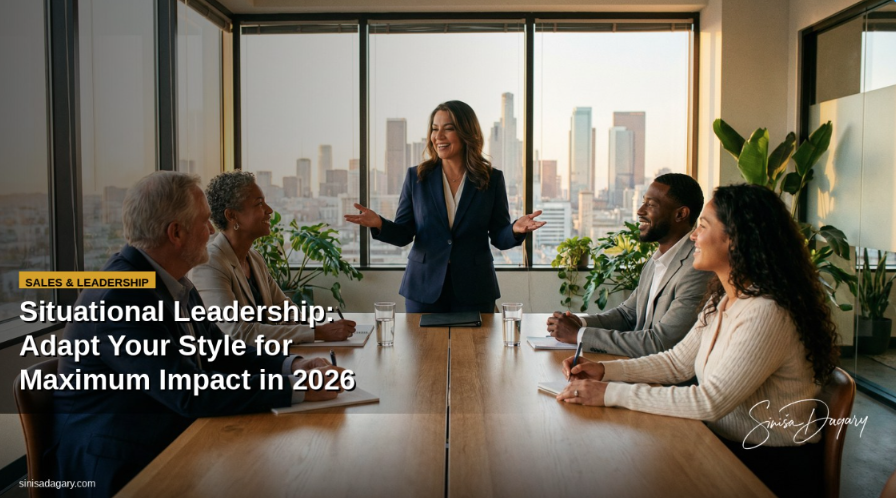
In the dynamic and ever-evolving business landscape of 2026, the most effective leaders are not those with a single, rigid leadership style. They are agile, adaptable, and emotionally intelligent chameleons who can tailor their approach to fit the specific needs of their team members and the situation at hand. This is the core principle of Situational Leadership®, a powerful and practical framework developed by Dr. Paul Hersey and Ken Blanchard in the late 1960s. Decades later, it remains one of the most enduring and widely-used leadership models in the world.
The core idea, which I find incredibly powerful, is that there is no single "best" style of leadership. Effective leadership is task-relevant, and the most successful leaders are those who can adapt their style to the performance readiness (ability and willingness) of the individual or group they are attempting to lead or influence. Research published by Harvard Business Review confirms that leaders who adapt their style to context consistently outperform those with a fixed approach by up to 34%. If you're a sales leader, mastering this model is a total game-changer. A sales team is rarely homogenous; it is a mix of new hires, seasoned veterans, high-performers, and those who are struggling. Applying the same leadership style to each of them is a recipe for mediocrity.
In this guide, I want to take you on a deep dive into the Situational Leadership® model. We'll break down the four leadership styles, the four development levels, and most importantly, how to match them for maximum impact. We will explore practical applications, especially in a sales context, to help you unlock the full potential of your team.
"The key to successful leadership today is influence, not authority." - Ken Blanchard
Part 1: Understanding the Situational Leadership® Model
The model is based on two fundamental concepts: Leadership Style and the Development Level of the follower.
The Four Leadership Styles (S1-S4)
Leadership style is determined by the combination of two behaviors:
1.Task Behavior (Directive): The extent to which the leader engages in one-way communication by explaining what each follower is to do, as well as when, where, and how tasks are to be accomplished.
2.Relationship Behavior (Supportive): The extent to which the leader engages in two-way or multi-way communication. This includes listening, facilitating, and providing supportive behaviors.
Combining these two behaviors creates four distinct leadership styles. According to Gallup's State of the Global Workplace report, managers who adapt their leadership style to individual team members see up to 23% higher employee engagement scores.
Style
Task Behavior
Relationship Behavior
Description
S1: Directing
High
Low
The leader provides specific instructions and closely supervises task accomplishment.
S2: Coaching
High
High
The leader continues to direct and closely supervise task accomplishment, but also explains decisions, solicits suggestions, and supports progress.
S3: Supporting
Low
High
The leader facilitates and supports the follower's efforts toward task accomplishment and shares responsibility for decision-making with them.
S4: Delegating
Low
Low
The leader turns over responsibility for decision-making and problem-solving to the follower.
[Insert Image: A diagram of the Situational Leadership® model, showing the four quadrants (S1, S2, S3, S4) with Task Behavior on the X-axis and Relationship Behavior on the Y-axis.]
The Four Development Levels (D1-D4)
Development level is the degree to which a follower has the competence and commitment necessary to accomplish a particular task or activity. It is crucial to remember that development level is task-specific. A person might be a D4 on one task but a D1 on a new, unfamiliar task.
•Competence: A function of knowledge and skills.
•Commitment: A function of confidence and motivation.
This creates four development levels:
Level
Competence
Commitment
Description
D1: Enthusiastic Beginner
Low
High
The individual is new to the task but is eager and willing to learn. They lack the skills but are highly motivated.
D2: Disillusioned Learner
Some
Low
The individual has some experience but has become frustrated or discouraged. Their motivation has dropped.
D3: Capable but Cautious Performer
High
Variable
The individual has the skills to do the job but is hesitant or lacks the confidence to do it on their own.
D4: Self-Reliant Achiever
High
High
The individual has the skills, confidence, and motivation to work independently. They are a high-performer.
Part 2: Matching Leadership Style to Development Level
The power of the model lies in matching the correct leadership style to the follower's development level.
•D1 (Enthusiastic Beginner) → S1 (Directing): A new team member needs clear direction. They are excited to learn, so you don't need to provide a lot of supportive behavior, but you do need to tell them exactly what to do and how to do it.
•D2 (Disillusioned Learner) → S2 (Coaching): The team member's motivation has dropped, so they need both high direction (because they are still learning) and high support (to rebuild their confidence and commitment). This is where a leader needs to be a coach, providing encouragement and explaining the "why" behind the tasks.
•D3 (Capable but Cautious Performer) → S3 (Supporting): The team member has the skills, but they are not confident. They don't need you to tell them what to do, but they do need you to be a sounding board, to encourage them, and to help them build confidence. The leader acts as a facilitator.
•D4 (Self-Reliant Achiever) → S4 (Delegating): The high-performer is both able and willing. Get out of their way! Delegate tasks and trust them to get the job done. Your role is to provide resources and remove obstacles.
[Insert Image: A visual that connects the four Development Levels (D1-D4) to the four Leadership Styles (S1-S4) with arrows.]
Part 3: Situational Leadership in Action: A Sales Team Scenario
Let's apply the model to a typical sales team.
Scenario: You are a sales manager with four team members.
•Anna (D1): A recent graduate, just joined the team. She is incredibly enthusiastic but has no real-world sales experience.
•Your Approach (S1 - Directing): You provide Anna with a detailed 30-60-90 day plan. You give her a script for her first calls, a specific list of leads to contact, and you schedule daily check-ins to review her progress.
•Ben (D2): Has been with the company for 6 months. He knows the product but has been struggling to meet his quota for the last two months and is becoming quiet and withdrawn.
•Your Approach (S2 - Coaching): You schedule a one-on-one with Ben. You listen to his frustrations, acknowledge his challenges, and then work with him to diagnose the problem. You role-play different scenarios, provide specific feedback on his calls, and celebrate small wins to rebuild his motivation.
•Carla (D3): A senior salesperson who consistently hits her numbers. However, she is hesitant to take on a leadership role in a major new account pitch.
•Your Approach (S3 - Supporting): You meet with Carla and ask her what she needs to feel confident about leading the pitch. You act as her sounding board, help her brainstorm ideas, and offer your support and resources. You let her take the lead but make it clear you are there to back her up.
•David (D4): Your top performer for the last three years. He is a master of the sales process and is highly motivated.
•Your Approach (S4 - Delegating): You give David the responsibility of mentoring Anna. You also delegate the task of developing a new sales strategy for an untapped market segment, giving him the autonomy and resources to run with it.
Part 4: Developing Your Situational Leadership® Capability
Knowing the theory is one thing; applying it consistently under pressure is another. Here is a practical framework for developing your situational leadership capability.
Step 1: Build Your Diagnostic Muscle
The foundation of situational leadership is accurate diagnosis. The most effective way to improve your diagnostic ability is through regular, structured one-on-one conversations. During these conversations, ask open-ended questions about your team member's confidence, their understanding of the task, and the challenges they are facing. Listen actively and observe their body language. Over time, you will develop an intuitive sense for where each person is on the development continuum.
Step 2: Expand Your Behavioral Range
Most leaders have a default style that they rely on in most situations. The goal is to expand your behavioral range so that all four styles are readily available to you. A practical way to do this is to identify your least-used style and deliberately practice it in low-stakes situations. For example, if you tend to be a delegator (S4), practice giving more structured direction (S1) when onboarding a new team member.
Step 3: Create a Feedback Loop
Ask your team members for feedback on your leadership style. This requires psychological safety and trust, but it is the most powerful way to calibrate your approach. You might be surprised to find that your perception of your style is very different from how your team experiences it.
Step 4: Integrate with Other Frameworks
Situational Leadership® works best when integrated with other leadership and coaching frameworks. The GROW Coaching Model, for example, is an excellent tool for conducting the coaching (S2) and supporting (S3) conversations. OKRs (Objectives and Key Results) can be used to set clear goals, which is the first step in determining the appropriate leadership style. For more on OKRs, see our article on Strategic Planning with OKRs.
For leaders looking to develop their teams and find the right talent for their organizations, platforms like Investra.io offer valuable resources and connections within the business community. Additionally, for those seeking professional development resources and networking opportunities, Findes.si is a valuable platform for connecting with the right professionals and opportunities.
Part 5: Situational Leadership® in the Age of Remote and Hybrid Work
The rise of remote and hybrid work has added a new layer of complexity to situational leadership. When you cannot observe your team members in person, diagnosing their development level requires more intentionality.
Adapting for Remote Teams:
Challenge
Situational Leadership® Solution
Reduced visibility
Increase the frequency of one-on-one check-ins, especially for D1 and D2 team members
Communication gaps
Be more explicit and detailed in your written communications; over-communicate direction and support
Isolation and disengagement
Proactively check in on the emotional well-being of your team; use video calls to build connection
Asynchronous work
Provide clear, written instructions and expectations for D1 team members; give D4 team members the autonomy to manage their own schedules
Building trust remotely
Be consistent, reliable, and follow through on your commitments; recognize and celebrate achievements publicly
The key principle remains the same: adapt your style to the individual's needs. A D1 remote employee needs just as much direction and encouragement as a D1 employee in the office—it just needs to be delivered differently.
Part 6: The Situational Leader's Coaching Questions Toolkit
One of the most practical tools a situational leader can have is a repertoire of powerful coaching questions tailored to each development level. The right question, asked at the right time, can unlock a team member's potential and accelerate their development.
Questions for D1 (Enthusiastic Beginner) — S1 Directing Style
When working with a D1, your questions should be focused on clarifying expectations, providing direction, and building initial confidence. The goal is to give them a clear roadmap.
•"What is your understanding of the goal we are trying to achieve?"
•"What are the three most important steps you need to take this week?"
•"What resources do you have available, and what do you still need?"
•"What does success look like for this task at the end of the day?"
•"Let me walk you through the process step-by-step — what questions do you have?"
Questions for D2 (Disillusioned Learner) — S2 Coaching Style
For a D2, your questions need to acknowledge their frustration, rebuild their confidence, and help them diagnose and solve the problems they are facing. The goal is to re-ignite their motivation.
•"I've noticed you seem a bit frustrated lately. What's going on from your perspective?"
•"What has been working well, even if things have been tough overall?"
•"What do you think is the root cause of the challenge you're facing?"
•"What options do you see for moving forward? What would you try if you knew you couldn't fail?"
•"What can I do to support you better?"
Questions for D3 (Capable but Cautious) — S3 Supporting Style
For a D3, your questions should focus on building their confidence and encouraging them to trust their own judgment. The goal is to help them see that they already have the skills to succeed.
•"You've done this kind of thing before — what approach would you take?"
•"What's holding you back from making this decision on your own?"
•"If you were advising a colleague in this situation, what would you tell them to do?"
•"What would need to be true for you to feel confident moving forward?"
•"I trust your judgment on this — what do you think is the right call?"
Questions for D4 (Self-Reliant Achiever) — S4 Delegating Style
For a D4, your questions should focus on expanding their horizons, challenging them with new opportunities, and ensuring they feel valued and recognized.
•"Given your experience, I'd like your perspective on a strategic challenge we're facing. What do you think?"
•"What's the next big challenge you want to tackle? What would stretch you?"
•"If you had full autonomy and resources, how would you approach this problem?"
•"What are you learning right now, and how can I support your continued growth?"
•"You've done exceptional work on this project. How do you think we can scale this approach across the team?"
For leaders who want to deepen their coaching skills and find the right training resources, Investra.io connects business professionals with the tools and networks they need to grow. And for finding specialized leadership and coaching trainers in the region, Findes.si is an invaluable resource.
Conclusion: Leadership is a Dance, Not a March
Situational Leadership® is not a rigid set of rules but a flexible and dynamic framework. It requires leaders to be astute observers of their team members, to diagnose their development level on a task-by-task basis, and to have the agility to switch between leadership styles seamlessly. It moves leadership from a monologue to a dialogue, from a march to a dance.
In 2026, the ability to lead situationally is what separates good managers from great leaders. By mastering this model, you can create a more engaged, motivated, and high-performing team, and ultimately, drive better results for your organization.
Frequently Asked Questions (FAQ)
1. Is the Situational Leadership® model still relevant today?
Absolutely. While the business environment has changed, the core principles of adapting leadership style to the individual's needs are more relevant than ever.
2. Can you use this model with a whole team, not just individuals?
Yes, you can assess the development level of the entire team on a specific goal and adapt your style accordingly. For example, if the team is new to a project, you would use a more directive (S1) approach with the group as a whole.
3. What is the biggest mistake leaders make when applying this model?
The most common mistake is misdiagnosing the development level. For example, treating a D2 (Disillusioned Learner) like a D1 (Enthusiastic Beginner) by only providing direction and no support can further demotivate them.
4. How does this model relate to other leadership theories?
It complements many other theories. For example, it provides a practical "how-to" for applying the principles of emotional intelligence in a leadership context. Daniel Goleman's research on emotional intelligence, published in Harvard Business Review, directly supports the adaptive approach at the heart of Situational Leadership®.
5. Is it possible for a person to be at different development levels at the same time?
Yes, and this is a critical point. Development level is task-specific. A senior salesperson might be a D4 for closing deals but a D1 for using a new CRM system.
6. How can I improve my ability to diagnose development levels?
By having regular one-on-one conversations with your team members, actively listening to their concerns, and observing their performance on different tasks.
7. What if I am not naturally good at all four styles?
Most leaders have a preferred or default style. The key is to be self-aware and to consciously practice the other styles. It may feel unnatural at first, but with practice, you can become more agile.
8. How does this model apply to remote teams?
The principles are the same, but the application requires more intentionality. For example, a directive (S1) style with a remote employee might involve more frequent video check-ins and very clear written instructions. A McKinsey study on remote work found that remote workers with clearly defined expectations and regular check-ins are 2.5x more likely to feel engaged and productive.
9. Where can I learn more about Situational Leadership®?
The Center for Leadership Studies, founded by Dr. Paul Hersey, is the official home of the model and offers a wealth of resources and training programs.
10. How does this model connect with the GROW coaching model?
They are highly compatible. The GROW model (Goal, Reality, Options, Will) is an excellent tool for conducting the coaching (S2) and supporting (S3) conversations within the Situational Leadership® framework. For more on this, see our article on the [GROW Coaching Model](https://sinisadagary.com/en/blog-posts/the-grow-coaching-model-a-practical-guide-for-sales-leaders-in-2026 ).
Recommended Content
•Due Diligence: A Founder's Guide to M&A Success in 2026
•NFTs for Marketing: The Ultimate Guide to Customer Engagement in 2026
•The GROW Coaching Model: A Practical Guide for Sales Leaders in 2026
•Sales Leadership: Build a High-Performance Sales Team
•How to Use AI to Increase Sales by 300%: The Ultimate 2026 Playbook
•AI in Business: The 2026 Revolution You Can't Afford to Miss
•Strategic Planning with OKRs: The Ultimate Guide to Achieving Your Goals in 2026
•Advanced B2B Sales Techniques: How to Close High-Value Deals in 2026
•ChatGPT for Business: The Ultimate Guide to Unlocking AI-Powered Growth in 2026
•How to Build a Successful Personal Brand as an Expert in 2026
•Blue Ocean Strategy: How to Find Uncontested Market Space in 2026
•Management Consulting: The Complete Guide for Entrepreneurs