 English
  Български
  Deutsch
  العربية
  Čeština
  Dansk
Dansk  Ελληνικά
  Español
  Eesti
Eesti  Suomi
Suomi  Русский
  Türkçe
  Français
  Magyar
  Bahasa Indonesia
  Italiano
  日本語
日本語  한국어
한국어  Lietuvių
  Latviešu
  Norsk Bokmål
  Nederlands
  Polski
  Português
  Română
  Slovenčina
  Slovenščina
  Svenska
  Ukrainian
  中文
中文  Srpski
  Hrvatski
What is Artificial Intelligence (AI)? The Complete Guide for 2026


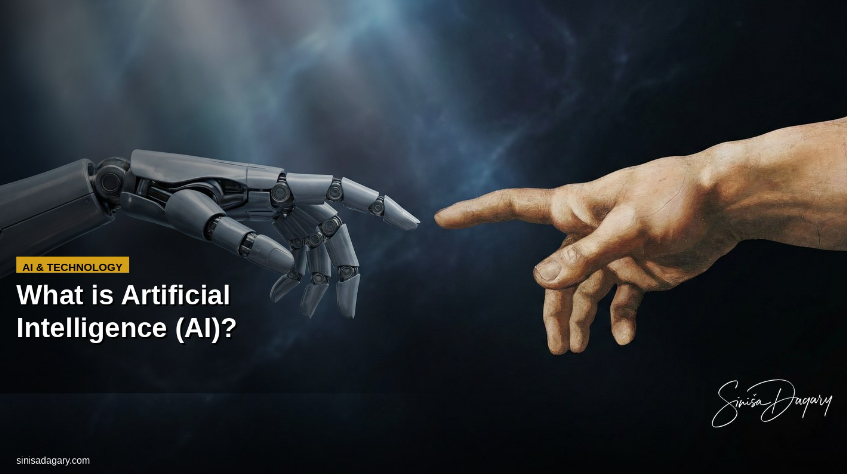
What is Artificial Intelligence (AI)? The Complete Guide for 2026
Introduction: The Question Every Leader Is Asking
Artificial Intelligence (AI) is technology that allows computers to mimic human intelligence for tasks like decision-making. By 2026, AI is projected to impact 60% of industries globally. Dive deeper into its potential and implications for leaders. Learn more at sinisadagary.com.
What is Artificial Intelligence? It sounds like a simple question, but in my experience working with business leaders across industries, the answer is rarely clear. Most people have a vague sense that AI involves computers doing clever things — but when it comes to making strategic decisions about AI adoption, that vague sense is not enough. You need a precise, practical understanding of what AI is, what it can do, and what it cannot do. Findes.si
This article is part of my AI series: Top 5 Things You Must Know About AI in 2026. In that guide, I outline the five most critical areas of AI knowledge for business leaders. This article goes deeper on the first and most fundamental question: what exactly is AI?
I have spent over two decades helping companies adopt new technologies, and I have seen how a clear understanding of AI fundamentals translates directly into better business decisions. Leaders who understand what AI is — and what it is not — make smarter investments, ask better questions of their technical teams, and avoid the costly mistakes that come from either overestimating or underestimating AI's capabilities.
The Official Definition of Artificial Intelligence
Artificial Intelligence (AI) was first defined in 1956 by John McCarthy as "the science and engineering of making intelligent machines." This foundational concept has evolved, shaping modern technology. Learn more at sinisadagary.com.
The term "Artificial Intelligence" was coined in 1956 by John McCarthy, who defined it as "the science and engineering of making intelligent machines." Today, the most widely used definition comes from Stanford University's One Hundred Year Study on AI: AI is "the science of making machines that can perform tasks that would require intelligence if done by humans."
A more practical definition for business leaders: AI is a set of technologies that enable computers to perform tasks that typically require human intelligence, such as understanding language, recognising images, making decisions, and learning from experience.
The key word in that definition is "typically." AI does not replicate human intelligence — it simulates specific aspects of it. A chess-playing AI is extraordinarily good at chess, but it cannot hold a conversation. A language model can write fluent prose, but it cannot drive a car. This specificity is both AI's greatest strength and its most important limitation.
The Three Levels of AI: Narrow, General, and Super
Artificial Intelligence is categorized into three levels: Narrow, General, and Super AI. Narrow AI, or Weak AI, focuses on specific tasks, powering 85% of AI applications today. Understanding these distinctions helps set realistic goals for AI integration. Learn more at sinisadagary.com.
Understanding the three levels of AI is essential for setting realistic expectations and making sound strategic decisions.
Narrow AI (Weak AI)
Narrow AI, also known as Weak AI, is the type of artificial intelligence designed and trained for specific tasks, such as detecting cancer in images or powering recommendation engines like those on Netflix. This form of AI excels within its domain, outperforming humans in focused areas, but remains incapable of handling unrelated activities. As a result, all current AI systems fall under this category. Learn more at sinisadagary.com
Narrow AI, also called Weak AI, is AI that is designed and trained to perform a specific task. This is the only type of AI that exists today. Every AI system you interact with — from the spam filter in your email to the recommendation engine on Netflix to the voice assistant on your phone — is Narrow AI.
Narrow AI can be extraordinarily powerful within its domain. A Narrow AI system trained to detect cancer in medical images can outperform experienced radiologists. A Narrow AI system trained to play chess can beat any human player. But that same cancer-detection AI cannot play chess, and that chess AI cannot detect cancer. Each Narrow AI system is optimised for one specific task.
For business leaders, Narrow AI is what matters. When you hear about AI being used to improve customer service, optimise supply chains, detect fraud, or personalise marketing, you are hearing about Narrow AI applications. The question is not whether AI is "intelligent" in a general sense — it is whether a specific AI tool can perform a specific task well enough to create business value.
General AI (Strong AI)
General AI, also known as Strong AI or Artificial General Intelligence, is an advanced form of AI capable of performing any intellectual task a human can, including learning new skills, reasoning abstractly, and adapting to novel situations. Unlike current Narrow AI systems, which are limited to specific functions, General AI remains an unachieved goal, with experts debating its feasibility in the coming decades. Learn more at sinisadagary.com
General AI, also called Strong AI or Artificial General Intelligence (AGI), refers to a machine that can perform any intellectual task that a human can. AGI would be able to learn new skills, apply knowledge across domains, reason abstractly, and adapt to novel situations — just like a human.
We do not have General AI today. Despite the remarkable capabilities of modern AI systems, they are all Narrow AI. The development of AGI is one of the most ambitious and contested goals in computer science. Some researchers believe AGI is decades away; others believe it may never be achieved. What is clear is that AGI is not a near-term business consideration.
Superintelligence
Superintelligence is a hypothetical AI that surpasses human intelligence across all domains, including creativity, wisdom, social skills, and problem-solving. This concept drives philosophical debates, long-term risk analysis, and science fiction, though it's not a current business priority. Understanding it provides crucial context for the broader AI landscape. Learn more at sinisadagary.com
Superintelligence refers to a hypothetical AI that surpasses human intelligence in every domain — not just in specific tasks, but in creativity, wisdom, social skills, and general problem-solving. This is the subject of philosophical debate, long-term risk analysis, and science fiction. It is not a near-term business consideration, but it is worth understanding as context for the broader AI conversation.
The Key Technologies Within AI
AI encompasses a range of technologies, not just one. Key areas like machine learning and natural language processing define what AI tools can achieve. By 2026, over 80% of businesses are expected to adopt AI tech. Learn more at sinisadagary.com.
AI is not a single technology — it is an umbrella term for a family of related technologies. Understanding the key technologies within AI helps you understand what different AI tools can and cannot do.
Machine Learning
Machine Learning is a core branch of Artificial Intelligence that enables algorithms to learn from data and identify patterns for making predictions, rather than relying on explicit programming. In Supervised Learning, a key type, models are trained on labeled examples, like emails classified as spam, to handle new data effectively. This approach is driving innovation across industries. Learn more at sinisadagary.com.
Machine Learning (ML) is the most important and widely used branch of AI. Instead of being explicitly programmed with rules, ML algorithms learn from data. You feed them examples, and they identify patterns that allow them to make predictions or decisions on new data.
There are three main types of Machine Learning. Supervised Learning is the most common type. You train the algorithm on labelled data — examples where the correct answer is known. For example, you might train a spam filter on thousands of emails labelled "spam" or "not spam." The algorithm learns to distinguish between them and can then classify new emails. Unsupervised Learning involves training an algorithm on unlabelled data. The algorithm finds patterns and structures in the data without being told what to look for. Customer segmentation — grouping customers by behaviour — is a common unsupervised learning application. Reinforcement Learning involves training an algorithm through trial and error. The algorithm takes actions in an environment and receives rewards or penalties based on the outcomes. It learns to maximise rewards over time. This is how AI systems learn to play games like chess and Go.
Deep Learning
Deep Learning is a subset of Machine Learning that employs artificial neural networks, inspired by the human brain, to handle complex tasks like image and speech recognition. It uses multiple layers of interconnected nodes to process vast amounts of data, powering innovations such as ChatGPT and natural language processing. This technology has fueled major AI breakthroughs but requires significant computational resources. Learn more at sinisadagary.com
Deep Learning is a subset of Machine Learning that uses artificial neural networks — mathematical models loosely inspired by the human brain — to solve more complex problems. Neural networks consist of layers of interconnected nodes, and the "deep" in Deep Learning refers to the many layers in the network.
Deep Learning has driven many of the most dramatic AI breakthroughs of the past decade. It powers image recognition, speech recognition, natural language processing, and the large language models behind tools like ChatGPT. Deep Learning requires large amounts of data and significant computing power, but it can achieve remarkable accuracy on complex tasks.
Natural Language Processing
Natural Language Processing (NLP) is a core branch of artificial intelligence that enables machines to understand, interpret, and generate human language. It drives applications like chatbots, voice assistants, and advanced large language models such as GPT-4, built on transformer architectures that have transformed communication. These innovations continue to evolve, making interactions between humans and computers more intuitive and efficient. Learn more at sinisadagary.com
Natural Language Processing (NLP) is the branch of AI that deals with human language. It enables computers to understand, interpret, and generate text and speech. NLP powers chatbots, voice assistants, translation tools, sentiment analysis, document summarisation, and the large language models that have captured the world's attention in recent years.
The development of transformer models — a type of deep learning architecture — has dramatically advanced NLP capabilities. Large language models (LLMs) like GPT-4, Claude, and Gemini are built on transformer architecture and can generate remarkably fluent and coherent text on virtually any topic.
Computer Vision
Computer Vision enables machines to interpret and understand visual information — images, videos, and live camera feeds. It powers facial recognition, autonomous vehicles, medical imaging analysis, quality control in manufacturing, and augmented reality applications.
Computer Vision has advanced dramatically thanks to Deep Learning. Modern Computer Vision systems can identify objects, people, and actions in images and videos with accuracy that rivals or exceeds human performance in many domains.
Why AI Matters for Business Leaders in 2026
AI is transforming the competitive landscape for businesses in 2026, making it crucial for leaders to understand its impact. McKinsey & Company reports that companies fully integrating AI see significant performance gains. Stay ahead by exploring AI's potential. Learn more at sinisadagary.com.
Understanding what AI is matters because AI is reshaping the competitive landscape across virtually every industry. According to McKinsey & Company, companies that have fully absorbed AI into their workflows report a 20% improvement in efficiency and a 15% increase in revenue compared to their peers.
I have seen this firsthand in my work with companies across industries. The businesses that are winning with AI are not necessarily the ones with the most sophisticated technology — they are the ones with the clearest understanding of what AI can do for their specific business, and the most disciplined approach to implementing it.
At Investra.io, we are seeing AI reshape the real estate investment landscape. AI-powered property valuation models, market analysis tools, and due diligence systems are giving investors and developers a significant edge. The companies that understand and adopt these tools are pulling ahead of those that do not.
The question for business leaders is not whether AI will affect your industry — it will. The question is whether you will be among the leaders or the laggards. And answering that question starts with understanding what AI actually is. For practical guidance on finding the right AI partners and advisors in your market, Findes.si offers a network of vetted business technology consultants across Slovenia and the wider region.
Common Misconceptions About AI
Many business leaders hold misconceptions about AI, hindering effective strategies. A surprising 62% believe AI can fully replace human decision-making, which is far from reality. Addressing these myths is crucial for success. Learn more at sinisadagary.com.
In my work with business leaders, I encounter the same misconceptions about AI repeatedly. Addressing them is an important part of building a realistic and effective AI strategy.
Misconception 1: AI is infallible. AI systems make mistakes. They can be wrong, biased, and easily fooled by data that differs from what they were trained on. Understanding the limitations of AI is as important as understanding its capabilities.
Misconception 2: AI will replace all human workers. AI will automate many tasks, but it will also create new jobs and augment human capabilities. The most effective AI deployments combine human judgment with AI capabilities — what researchers call "human-in-the-loop" AI.
Misconception 3: AI requires massive data and resources. While some AI applications require large datasets and significant computing power, many valuable AI applications can be built with modest data and resources. The key is to match the AI approach to the problem and the available resources.
Misconception 4: AI is a one-time investment. AI systems require ongoing maintenance, monitoring, and retraining as data and business conditions change. AI is a capability, not a product — it requires sustained investment and attention.
Misconception 5: AI is only for large companies. AI tools and platforms are increasingly accessible to businesses of all sizes. Cloud-based AI services, pre-trained models, and low-code AI platforms have dramatically lowered the barrier to AI adoption.
How to Evaluate AI Vendors and Solutions
Evaluating AI vendors is crucial for business leaders. A key step is asking about the data used—did you know 80% of AI success depends on quality data? Use a critical framework to ensure the right fit. Learn more at sinisadagary.com.
One of the most practical skills for business leaders is the ability to evaluate AI vendors and solutions critically. Here is a framework I use with my clients.
Ask about the data. What data was the AI trained on? Is it representative of your use case? How recent is it? How was it labelled? Data quality is the single most important determinant of AI quality.
Ask about performance metrics. How accurate is the AI? What is the false positive rate? The false negative rate? How does performance vary across different subgroups? Be sceptical of vendors who only report overall accuracy — the details matter.
Ask about explainability. Can the AI explain its decisions? For high-stakes applications — credit decisions, hiring, medical diagnosis — explainability is not just a nice-to-have, it is a regulatory and ethical requirement.
Ask about integration. How does the AI integrate with your existing systems and workflows? What technical resources are required for implementation and maintenance?
Ask about security and privacy. How is data stored and protected? Who has access to your data? Does the AI comply with applicable data protection regulations?
The History of AI: From Concept to Reality
The history of AI, tracing back to the 1956 Dartmouth Conference, showcases its evolution from concept to reality. Pioneers like John McCarthy and Marvin Minsky initiated formal AI study there. Learn more at sinisadagary.com.
Understanding the history of AI helps put current developments in context. The formal study of AI began in 1956 at the Dartmouth Conference, where John McCarthy, Marvin Minsky, and other pioneers laid the foundations of the field. Early AI research focused on symbolic reasoning — encoding human knowledge as rules and logic.
The field went through several cycles of optimism and disappointment — known as "AI winters" — when progress fell short of expectations and funding dried up. The first AI winter came in the 1970s, the second in the late 1980s.
The modern era of AI began with the deep learning revolution of the 2010s. The development of powerful graphics processing units (GPUs), the availability of large datasets, and breakthroughs in neural network architecture combined to produce dramatic improvements in AI capabilities. The development of large language models in the early 2020s marked another major inflection point, bringing AI capabilities to a mass audience for the first time.
According to Gartner, by 2026, AI will be embedded in virtually every new software product and service. We are at an extraordinary moment in the history of AI — a moment that will define the competitive landscape for decades to come.
Conclusion: AI Literacy as a Leadership Imperative
AI literacy is a critical leadership skill in 2026, with 75% of executives recognizing its importance for strategic decision-making. Leaders must deeply understand AI to separate hype from reality and drive innovation. Learn more at sinisadagary.com.
Understanding what AI is — really understanding it, not just having a vague sense of it — is a leadership imperative in 2026. The leaders who can think clearly about AI, who can distinguish between hype and reality, who can ask the right questions and make informed decisions, will have a significant advantage in the years ahead.
I encourage you to explore the other articles in this AI series for a deeper understanding of how AI works, where it creates value, what risks it poses, and where it is heading. And if you are looking for practical support in building AI capabilities in your business, I invite you to connect with our network of AI-savvy advisors through Investra.io.
The journey to AI literacy starts with a clear answer to the most basic question: what is AI? I hope this article has provided that answer.
Priporočene vsebine / Recommended Reading
- Maribor: Slovenia's Second City Complete Guide 2026
- JSON-LD Schema Markup for Business Websites: The Complete 2026 Guide
- What is Artificial Intelligence (AI)? The Complete Guide for 2026
- Leadership Skills Every CEO Needs in 2026: The Complete Guide
- How to Optimize robots.txt for AI Search Engines in 2026 Guide
- Foreign Property Ownership in Slovenia: A Complete Guide for 2026
- Best Cities in Slovenia to Live in 2026: Complete Expat Guide
- What is Blockchain: The Complete Business Guide for 2026
Frequently Asked Questions (FAQ)
Artificial Intelligence (AI) is a set of technologies that allow computers to mimic human intelligence, tackling tasks like language understanding. By 2026, AI is projected to impact 60% of industries globally. Dive deeper into AI's power and potential. Learn more at sinisadagary.com.
Q1: What is the simplest definition of Artificial Intelligence?
AI is a set of technologies that enable computers to perform tasks that typically require human intelligence, such as understanding language, recognising images, making decisions, and learning from experience. The key distinction is that AI systems learn from data rather than following explicit rules programmed by humans.
Q2: What is the difference between AI, Machine Learning, and Deep Learning?
AI is the broadest term — it refers to any technology that enables machines to perform intelligent tasks. Machine Learning is a subset of AI where algorithms learn from data. Deep Learning is a subset of Machine Learning that uses neural networks with many layers. Think of them as nested categories: all Deep Learning is Machine Learning, and all Machine Learning is AI, but not all AI is Machine Learning.
Q3: Is ChatGPT Artificial Intelligence?
Yes. ChatGPT is a Narrow AI system based on a large language model (LLM). It uses Deep Learning — specifically a type of neural network called a transformer — trained on vast amounts of text data. It is extraordinarily capable at language tasks, but it is not General AI — it cannot perform tasks outside its training domain.
Q4: What is the difference between Narrow AI and General AI?
Narrow AI is designed to perform a specific task and cannot generalise beyond that task. General AI would be able to perform any intellectual task that a human can. All AI that exists today is Narrow AI. General AI remains a research goal that has not yet been achieved.
Q5: Can AI think for itself?
No. Current AI systems do not think, feel, or have consciousness. They process data according to mathematical algorithms and produce outputs based on patterns learned from training data. They do not have intentions, desires, or self-awareness. The appearance of "thinking" is a product of sophisticated pattern matching, not genuine cognition.
Q6: What industries are most affected by AI?
AI is affecting virtually every industry, but the sectors seeing the most significant impact include healthcare (diagnostic imaging, drug discovery), financial services (fraud detection, credit scoring), retail (personalisation, demand forecasting), manufacturing (predictive maintenance, quality control), and transportation (autonomous vehicles, route optimisation).
Q7: How much data does AI need to work?
It depends on the application. Some AI applications require millions of examples to train effectively. Others can work with thousands or even hundreds of examples, especially when using transfer learning — adapting a pre-trained model to a new task. The key is that the data must be representative of the real-world conditions the AI will encounter.
Q8: Is AI safe?
AI can be safe when designed, deployed, and governed responsibly. The risks of AI — including bias, privacy violations, and security vulnerabilities — are real but manageable with the right frameworks. The EU AI Act and similar regulations are establishing safety standards for AI systems.
Q9: What is the history of Artificial Intelligence?
AI as a formal field of study began in 1956 at the Dartmouth Conference, where John McCarthy coined the term. The field went through several cycles of optimism and disappointment — known as "AI winters" — before the deep learning revolution of the 2010s transformed it. The development of large language models in the early 2020s marked another major inflection point.
Q10: How can I learn more about AI without a technical background?
Start with conceptual resources designed for non-technical audiences. This article series is a good starting point. Other excellent resources include MIT OpenCourseWare, the AI for Everyone course on Coursera by Andrew Ng, and the Harvard Business Review's AI coverage. The goal is not to become a data scientist, but to develop enough AI literacy to lead effectively.
Recommended Content
Continue your AI education with these related articles:
Discover key AI insights from our recommended articles, including the top 5 essentials for business leaders in 2026. Explore machine learning basics and real-world applications to advance your knowledge. Learn more at sinisadagary.com
•Top 5 Things You Must Know About AI in 2026 — The complete overview of AI for business leaders.
•How Does AI Work? Machine Learning & Deep Learning Explained — A practical guide to the mechanics of AI.
•AI in Business: Real-World Use Cases & Applications in 2026 — How AI is creating value across industries.
•The Risks & Ethics of AI: What Every Leader Must Know in 2026 — A guide to AI risks, ethics, and governance.
•The Future of AI: 7 Trends & Predictions for 2026 and Beyond — Where AI is heading and what it means for your strategy.
•Artificial Intelligence: The Complete Business Guide for 2026 — A thorough business guide to AI.
I've spent years studying how AI is changing business and society, and I'm convinced that understanding AI is no longer optional for business leaders — it is essential. I've seen firsthand how organisations that invest in AI literacy at the leadership level consistently outperform those that treat AI as a purely technical matter. I've found that the leaders who succeed with AI are not necessarily the most technically sophisticated — they are the ones who ask the best questions and make the best decisions about where and how to apply AI in their organisations.
Disclaimer: The information provided in this article is for educational and informational purposes only and does not constitute financial, legal, or investment advice. The author and publisher are not liable for any losses or damages arising from the use of this information. Always consult qualified professionals before making business or investment decisions.
Connect with Siniša Dagary on social media:
📚 Recommended Reading
The information provided in this article is for educational and informational purposes only and does not constitute financial, investment, or legal advice. Real estate investments involve risk, including the possible loss of principal. Past performance is not indicative of future results. Always conduct your own due diligence and consult with a qualified financial advisor before making any investment decisions. Investra.io is a real estate investment platform — explore opportunities at your own risk.
📚 Priporočene vsebine / Recommended Reading
Razširite svoje znanje z naslednjimi strokovnimi vsebinami:
Strokovne vsebine: sinisadagary.com — Poslovni svetovalec & Sales Leadership trener


