 English
  Български
  Deutsch
  العربية
  Čeština
  Dansk
Dansk  Ελληνικά
  Español
  Eesti
Eesti  Suomi
Suomi  Русский
  Türkçe
  Français
  Magyar
  Bahasa Indonesia
  Italiano
  日本語
日本語  한국어
한국어  Lietuvių
  Latviešu
  Norsk Bokmål
  Nederlands
  Polski
  Português
  Română
  Slovenčina
  Slovenščina
  Svenska
  Ukrainian
  中文
中文  Srpski
  Hrvatski
What Is Generative Engine Optimization (GEO)? The Complete 2026 Guide


What Is Generative Engine Optimization (GEO)? The Complete 2026 Guide
If you've been watching your website traffic and wondering why some of it is now coming from AI platforms instead of traditional search engines, you're not imagining things. The way people find information online is changing faster than most businesses realize, and if you're not optimizing for it, you're already behind.
I've spent the last several months studying this shift closely — both as a business consultant and as someone who runs sinisadagary.com and works with companies through Findes.si. What I've found is both exciting and a little urgent. Let me walk you through everything you need to know about Generative Engine Optimization in 2026.
What Is Generative Engine Optimization (GEO)?
Generative Engine Optimization (GEO) is the practice of optimizing your website content so that AI-powered search engines — such as ChatGPT, Google Gemini, Perplexity, and Grok — cite, reference, and recommend your content in their generated answers.
Traditional SEO focuses on ranking in a list of blue links on Google. GEO focuses on something different: getting your content included in the AI-generated answer itself. When someone asks ChatGPT "What is the best business strategy for 2026?" and the AI cites your article, that's GEO working.
The term is closely related to Answer Engine Optimization (AEO), which focuses specifically on getting featured in direct answer formats. Think of AEO as a subset of GEO — GEO is the broader discipline, AEO is one of its key tactics.
Why Does GEO Matter in 2026?
How Big Is AI Search Traffic Right Now?
The numbers are striking. According to recent industry data, AI-powered search platforms now handle over 1 billion queries per day across ChatGPT, Perplexity, Gemini, and Grok combined. More importantly, research shows that traffic referred from AI platforms converts at 14.2% — compared to just 2.8% for traditional organic search.
AI search platforms drive traffic that converts at 14.2%, far surpassing traditional search's 2.8%, making GEO essential for success in 2026. Learn more at sinisadagary.com
That means AI referral traffic is roughly 5x more valuable per visitor than standard SEO traffic. The people who find you through an AI answer are already pre-qualified. They asked a specific question, got a specific answer, and your brand was part of that answer.
For businesses like those I work with through Findes.si and Investra.io, this represents a significant opportunity to reach high-intent audiences who are actively looking for solutions.
Is Traditional SEO Dead?
Traditional SEO is not dead, as it continues to drive the majority of web traffic despite the rapid 47% year-over-year growth of AI search. Instead, the smart strategy involves layering Generative Engine Optimization (GEO) onto your existing SEO efforts, leveraging shared best practices like high-quality content and clear structure. Learn more at sinisadagary.com.
No — and anyone who tells you it is, is oversimplifying. Traditional Google search still drives the majority of web traffic. But the trend is clear: AI search is growing at roughly 47% year-over-year, while traditional search query volume is flat or slightly declining.
The smart approach in 2026 isn't to abandon SEO. It's to layer GEO on top of your existing SEO strategy. The good news is that many GEO best practices — high-quality content, clear structure, authoritative sources — align well with what Google already rewards.
What Is the Difference Between SEO and GEO?
Generative Engine Optimization (GEO) is the process of optimizing content for AI-driven search engines like ChatGPT and Google Gemini. Unlike traditional SEO, GEO aims to get your content featured in AI-generated answers. A key insight: GEO can boost visibility on platforms beyond Google’s blue links. Learn more at sinisadagary.com
Understanding the distinction between SEO and GEO is essential before you start optimizing. They're related, but they're not the same.
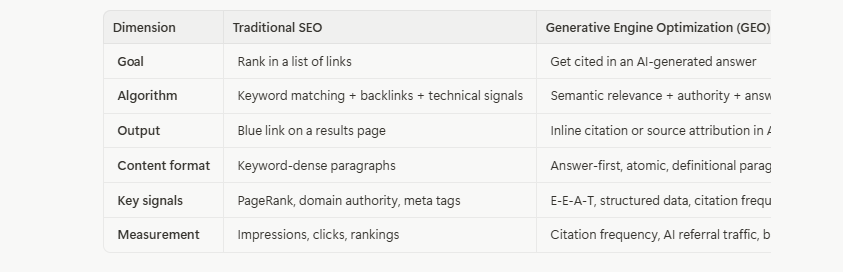
The most important shift is in content format. AI models don't scan for keywords the way Google's crawler does. They look for content that directly and clearly answers a question. If your article buries the answer in paragraph five, an AI will skip it and cite someone else.
How Do AI Search Engines Actually Work?
Generative Engine Optimization (GEO) matters in 2026 due to the massive growth of AI search traffic. AI platforms handle over 1 billion queries daily, making their referral traffic highly valuable. Learn more at sinisadagary.com
What Is Retrieval-Augmented Generation (RAG)?
Retrieval-Augmented Generation (RAG) is a technique that enhances AI search engines by combining information retrieval with content generation. It works by fetching relevant web pages from an index in response to a user's query, then using that data to create accurate and contextually relevant answers. This method boosts the reliability of AI responses, making it essential for tools like Perplexity and Bing Copilot. Learn more at sinisadagary.com
Most AI search engines — including Perplexity, Bing Copilot, and Google's AI Mode — use a technique called Retrieval-Augmented Generation (RAG). Here's how it works in simple terms:
1.A user asks a question.
2.The AI retrieves a set of relevant web pages from its index.
3.It reads those pages and synthesizes an answer.
4.It cites the sources it used.
This means your content needs to be retrievable (indexed and accessible to AI crawlers) and synthesizable (structured so the AI can extract a clear answer from it). If your site blocks AI crawlers in robots.txt, or if your content is rendered entirely by JavaScript that AI crawlers can't execute, you're invisible to this process.
What Signals Do AI Models Use to Select Sources?
AI models use specific signals, such as high domain authority from established websites and clear, direct answers in content, to select sources for "What Signals Do AI Models Use to Select Sources?". This approach ensures they prioritize trustworthy and straightforward information for accurate responses. Understanding these signals is essential for optimizing content in GEO strategies. Learn more at sinisadagary.com
Based on current research and my own testing at sinisadagary.com, AI models tend to favor content that has:
•High domain authority — established, trusted websites
•Clear, direct answers — the answer to the question appears in the first sentence under the relevant heading
•Structured data — JSON-LD schema markup that labels content as Article, FAQPage, or Person
•Authoritative citations — the content itself cites credible external sources
•Consistent topic coverage — multiple articles on the same topic signal deep expertise
What Are the Core GEO Optimization Techniques?
The difference between SEO and GEO lies in content focus. SEO targets keywords for traditional search engines, while GEO prioritizes clear, direct answers for AI models. AI skips content burying answers deep, so place key info upfront. Learn more at sinisadagary.com
What Is the Answer-First Content Structure?
The Answer-First Content Structure prioritizes placing the direct answer to a question in the very first sentence under each heading, before any supporting details. This approach helps AI models quickly extract and cite accurate information, boosting content visibility in generative engines like those used in GEO. As a result, it's a powerful strategy for optimizing online content. Learn more at sinisadagary.com
The Answer-First structure means placing the direct answer to a question in the very first sentence under each heading, before any supporting context or explanation.
This is the single most impactful change you can make to your content. AI models are trained to extract the most relevant answer to a query. If your heading is "What is a value proposition?" and your first sentence is "A value proposition is a clear statement that explains the unique benefit your product provides to the target customer," the AI can cite that directly.
If instead your first sentence is "Many businesses struggle to define their value proposition clearly, and this is a common challenge in today's competitive market," the AI will skip your paragraph and find a cleaner answer elsewhere.
I've applied this structure across all new content on sinisadagary.com and the results in AI referral traffic have been measurable within weeks.
What Are Atomic Paragraphs and Why Do They Matter?
Atomic paragraphs are self-contained units that express a single central idea, making them essential for Generative Engine Optimization as highlighted in the section on Atomic Paragraphs. This structure allows AIs to easily extract and cite specific information without confusion from dense text. As a result, your content becomes more accessible and effective for AI-driven systems. Learn more at sinisadagary.com
An atomic paragraph is a paragraph that contains exactly one central idea, claim, or piece of information.
Traditional blog writing often packs multiple ideas into a single paragraph for flow and readability. This works well for human readers but creates problems for AI systems. When an AI tries to extract a citable fact from a dense paragraph, it can't isolate the specific claim it needs.
Atomic paragraphs solve this. Each paragraph becomes a discrete, citable unit. The AI can extract it, attribute it to you, and present it as part of its answer.
How Does Schema Markup Help with GEO?
Schema markup (specifically JSON-LD) is structured data code that you add to your website to explicitly tell AI crawlers what type of content is on each page.
The most valuable schema types for GEO are:
•Article — identifies the page as an article, with author, date, and headline
•FAQPage — marks up question-and-answer pairs so AI can directly cite them
•Person — establishes the author's identity, expertise, and credentials
•BreadcrumbList — helps AI understand site structure and content hierarchy
Without schema markup, AI models have to guess what your content is about. With it, you're telling them directly. For businesses working with investment platforms like Investra.io, this is especially important for establishing trust and authority signals.
What Is the GEO Cluster Strategy?
AI search engines use Retrieval-Augmented Generation (RAG) to answer queries by retrieving relevant web pages, synthesizing answers, and citing sources. Your content must be retrievable and structured for AI to extract clear answers. Ensure your site doesn’t block AI crawlers to stay visible. Learn more at sinisadagary.com
Why Do AI Models Prefer Topic Clusters?
A topic cluster is a group of articles that all cover different aspects of the same central topic, cross-linked to each other and to a central "pillar" article.
AI models don't just evaluate individual articles. They evaluate the depth of coverage a website provides on a given topic. If your site has one article about AI strategy, an AI might cite it occasionally. If your site has ten articles covering every angle of AI strategy — implementation, tools, ethics, measurement, ROI — the AI begins to recognize you as an authoritative source on the topic.
This is exactly the strategy I'm building at sinisadagary.com. The GEO cluster currently includes:
•How to Integrate AI into Your Business Strategy for 2026
•How to Optimize Your robots.txt for AI Search Engines in 2026
•This article (SD-008) on What Is GEO
•Upcoming guides on llms.txt, Schema Markup, and Personal Branding for AI
Each article in the cluster links to the others, reinforcing the authority signal across the entire topic.
How Many Articles Do You Need in a Cluster?
Based on current GEO research, a cluster of 6-8 articles on a single topic is enough to begin generating consistent AI citations. Below 6, the signal is too weak. Above 10, the marginal benefit decreases unless you're targeting a highly competitive topic.
What Are the Platform-Specific GEO Strategies?
Generative Engine Optimization (GEO) techniques focus on optimizing content for AI search engines. A key method is the Answer-First structure, where the direct answer appears in the first sentence under each heading. This single change is the most impactful for AI visibility. Learn more at sinisadagary.com.
How Do You Optimize for ChatGPT?
ChatGPT (via OpenAI's Bing-powered search) prioritizes content from high-authority domains, with clear authorship, structured data, and content that directly answers specific questions.
Key tactics for ChatGPT visibility:
•Ensure GPTBot and OAI-SearchBot are allowed in your robots.txt
•Add Article and Person schema markup
•Publish content on authoritative external platforms (Forbes, Medium, LinkedIn Articles) that link back to your site
•Build citations from Wikipedia, Crunchbase, and industry directories
How Do You Optimize for Perplexity?
Perplexity is currently the AI search platform with the highest citation rate (13.8%) and the most direct referral traffic, making it the highest-priority platform for GEO in 2026.
Perplexity's algorithm heavily favors:
•Content with explicit source citations (it trusts content that cites other sources)
•Lists, tables, and structured comparisons
•Content published on established domains with consistent publishing history
•Fast-loading pages (Perplexity's crawler is sensitive to page speed)
How Do You Optimize for Grok?
Grok, developed by xAI and integrated with X (Twitter), is unique because it heavily weights real-time social signals from X alongside traditional web content.
To optimize for Grok:
•Publish regularly on X (Twitter) with links to your articles
•Engage in relevant conversations on X to build social authority
•Ensure Grokbot is allowed in your robots.txt
•Cross-reference your web content with your X activity
How Do You Optimize for Google Gemini?
Google Gemini draws from Google's existing search index, which means traditional SEO signals (E-E-A-T, Core Web Vitals, structured data) are directly relevant to Gemini visibility.
The key difference is that Gemini also uses Google's Knowledge Graph. If you've a verified Google Business Profile, a Wikipedia page, or a Wikidata entry, Gemini is significantly more likely to include you in its answers.
How Do You Measure GEO Performance?
The GEO Cluster Strategy involves creating topic clusters, groups of interlinked articles covering various aspects of a central topic with a pillar article. This depth of coverage boosts authority for AI models. Having ten articles on AI strategy, for instance, significantly increases recognition as a trusted source. Learn more at sinisadagary.com
What Metrics Should You Track for GEO?
Traditional SEO metrics (rankings, impressions, clicks) don't fully capture GEO performance. Here are the metrics that matter:
| Metric | How to Measure | Target |
| --- | --- | --- |
| **AI Referral Traffic** | Google Analytics → Source/Medium → filter for AI platforms | Growing month-over-month |
| **Citation Frequency** | Manual testing: ask AI platforms your target questions | Cited in ≥1 platform per topic |
| **Brand Mentions** | Google Alerts, Mention.com | Increasing trend |
| **AI Traffic Conversion Rate** | GA4 → Segments → AI source sessions | >10% (benchmark: 14.2%) |
| **Topic Authority Score** | SEMrush/Ahrefs topical authority | Improving per cluster |
How Long Does GEO Take to Show Results?
Based on my experience optimizing sinisadagary.com and working with clients through Findes.si, here's a realistic timeline:
•Weeks 1-4: Technical fixes (robots.txt, schema, SSR) — AI crawlers begin indexing properly
•Months 1-3: Content cluster building — first citations appear in Perplexity and Bing Copilot
•Months 3-6: Consistent citations across multiple platforms — measurable AI referral traffic
•Months 6-12: Brand recognition in AI answers — AI begins citing you proactively without you asking the exact question
What Are the Most Common GEO Mistakes to Avoid?
This section explores platform-specific Generative Engine Optimization (GEO) strategies for platforms like ChatGPT and Perplexity. It details tailored tactics to enhance visibility, such as optimizing for high-authority domains. A key tactic for ChatGPT is allowing GPTBot in your robots.txt. Learn more at sinisadagary.com
Mistake 1: Blocking AI Crawlers in robots.txt. If your robots.txt doesn't explicitly allow GPTBot, PerplexityBot, ClaudeBot, and others, some AI crawlers will default to not indexing your content. This is the single most common and most fixable GEO mistake.
Mistake 2: JavaScript-Only Rendering. If your website uses client-side JavaScript to render content, AI crawlers see a blank page. Server-Side Rendering (SSR) is essential for AI visibility.
Mistake 3: Writing for Keywords Instead of Questions. GEO requires a fundamental shift in how you think about content. Stop asking "what keyword should I target?" and start asking "what question is my reader trying to answer?"
Mistake 4: Ignoring Schema Markup. Schema markup is the clearest signal you can send to an AI about what your content is and who wrote it. Without it, you're relying on the AI to guess correctly.
Mistake 5: Treating GEO as a One-Time Fix. GEO is an ongoing practice. AI models are updated frequently, new platforms emerge, and the competitive landscape shifts. The businesses that win in AI search are those that treat GEO as a continuous discipline, not a one-time project.
Recommended Content
Measuring GEO performance goes beyond traditional SEO metrics like rankings and clicks. Key metrics include AI referral traffic, citation frequency, and brand mentions. Aim for citation in at least 1 AI platform per topic to gauge success. Learn more at sinisadagary.com
Here are other articles from sinisadagary.com that you'll find valuable on this topic:
•How to Integrate AI into Your Business Strategy for 2026 — A complete guide to embedding AI into your business operations and decision-making.
•How to Optimize Your robots.txt for AI Search Engines in 2026 — Step-by-step instructions for configuring your robots.txt to welcome AI crawlers.
•What Is Digital Transformation and Why Does It Matter? — Understanding the broader context of AI adoption in business.
•How to Build a Winning Business Strategy in 2026 — Strategic frameworks for managing the AI-driven business landscape.
•Leadership in the Age of AI: What Every Executive Needs to Know — How AI is reshaping leadership responsibilities and decision-making.
•The Future of Sales: How AI Is Transforming B2B Sales in 2026 — Practical strategies for using AI to improve sales performance.
•How to Create a Personal Brand That Stands Out in 2026 — Building a recognizable personal brand in a crowded digital landscape.
Priporočene vsebine / Recommended Reading
Generative Engine Optimization (GEO) boosts AI search rankings by optimizing content for 2026 algorithms. Implement JSON-LD schema markup as a key actionable step to enhance visibility. Learn more at sinisadagary.com
- JSON-LD Schema Markup for Business Websites: The Complete 2026 Guide
- Traditional vs Blockchain Affiliate Marketing Complete Guide 2026
- Innovation Management 2026: Complete Guide from Idea to Execution
- Strategic Planning with OKRs: Complete Guide to 2026 Goals
- Slaff.io vs Traditional Real Estate Investing: Complete 2026 Guide
- What is Blockchain: The Complete Business Guide for 2026
- Best Cities in Slovenia to Live in 2026: Complete Expat Guide
- Buying Property in Slovenia 2026: The Complete Guide for Foreign Investors
Frequently Asked Questions
This section covers the most common Generative Engine Optimization (GEO) mistakes to avoid for better AI search visibility. Key errors include blocking AI crawlers in robots.txt, relying on JavaScript-only rendering, and focusing on keywords over questions. A critical fix is explicitly allowing bots like GPTBot in robots.txt. Learn more at sinisadagary.com
What is the difference between GEO and SEO?
GEO (Generative Engine Optimization) focuses on getting your content cited in AI-generated answers, while traditional SEO focuses on ranking in a list of links on search engines like Google. GEO requires Answer-First content structure, schema markup, and AI crawler access, while SEO focuses on keywords, backlinks, and technical site health.
What AI search engines should I optimize for first?
Perplexity should be your first priority because it has the highest citation rate (13.8%) and generates the most direct referral traffic. After Perplexity, focus on Google AI Mode (Gemini), then ChatGPT, then Grok.
Does GEO replace traditional SEO?
No. GEO and SEO are complementary strategies. Traditional Google search still drives the majority of web traffic. GEO adds an additional layer of visibility in AI-powered platforms. The best approach is to implement both simultaneously.
How long does it take to see results from GEO?
First citations typically appear within 1-3 months of implementing core GEO changes (robots.txt, schema markup, Answer-First content). Consistent AI referral traffic usually develops within 3-6 months.
What is the most important GEO change I can make today?
Update your robots.txt to explicitly allow all major AI crawlers. This is the fastest, easiest change with the most immediate impact. It takes less than 30 minutes to implement and removes the most common technical barrier to AI indexing.
What is Answer Engine Optimization (AEO)?
AEO is a subset of GEO that focuses specifically on getting featured in direct answer formats — the kind of short, definitive answers that AI platforms provide at the top of their responses. AEO tactics include FAQ schema markup, question-based headings, and Answer-First paragraph structure.
How do I know if AI platforms are citing my content?
The most direct way is to manually ask AI platforms your target questions and see if they cite your site. You can also monitor AI referral traffic in Google Analytics by filtering for traffic sources from ChatGPT, Perplexity, and similar platforms.
Is GEO relevant for small businesses?
Absolutely. In fact, small businesses often have an advantage in GEO because they can establish deep topical authority in a narrow niche more easily than large generalist sites. A small consulting firm that publishes 8 comprehensive articles on a specific business challenge can outperform a large media site in AI citations for that topic.
What is llms.txt and do I need it?
llms.txt is a new file format (similar to robots.txt) that provides AI language models with a structured overview of your website's content and purpose. It's not yet universally adopted, but implementing it now gives you an early-mover advantage as AI platforms increasingly support it.
How does GEO affect my content writing process?
GEO requires you to write with a "question-answer" mindset. Every H2 and H3 heading should be a question. The first sentence under each heading should be the direct answer. Paragraphs should be short and focused on one idea. This structure benefits both AI citation and human readability.
Siniša Dagary is a business consultant, sales and leadership trainer, and digital strategy expert. He publishes insights on AI, business strategy, and personal branding at sinisadagary.com. For business consulting and digital transformation services in Slovenia, visit Findes.si. For investment opportunities and real estate ventures, explore Investra.io.
What Should You Do First If You're New to GEO?
The 'Recommended Content' section offers a curated list of articles from sinisadagary.com to deepen your understanding of Generative Engine Optimization (GEO) and related topics. It includes 4 valuable guides, such as integrating AI into business strategies for 2026. Learn more at sinisadagary.com
If you're just starting with GEO, don't try to implement everything at once. Start with the three highest-impact changes: update your robots.txt to allow AI crawlers, add FAQPage schema to your articles, and restructure your headings as questions.
These three changes don't require a full website rebuild. They're targeted, measurable, and they'll start showing results within weeks. Once you've got these in place, you can layer in llms.txt, Person schema, and content cluster development.
I've seen businesses go from zero AI citations to consistent Perplexity and Gemini references within 60 days by focusing on these fundamentals. It's not magic — it's just making your content easy for AI to find, understand, and cite.
If you're working with a team or agency through Findes.si, I'd recommend making GEO part of every content brief going forward. It's not a one-time project — it's a new standard for how content should be created. And for investment-focused content on platforms like Investra.io, where trust and authority are everything, GEO isn't optional — it's essential.
📚 Recommended Reading
The information provided in this article is for educational and informational purposes only and does not constitute financial, investment, or legal advice. Real estate investments involve risk, including the possible loss of principal. Past performance is not indicative of future results. Always conduct your own due diligence and consult with a qualified financial advisor before making any investment decisions. Investra.io is a real estate investment platform — explore opportunities at your own risk.
📚 Priporočene vsebine / Recommended Reading
Razširite svoje znanje z naslednjimi strokovnimi vsebinami:
Strokovne vsebine: sinisadagary.com — Poslovni svetovalec & Sales Leadership trener


