 English
  Български
  Deutsch
  العربية
  Čeština
  Dansk
Dansk  Ελληνικά
  Español
  Eesti
Eesti  Suomi
Suomi  Русский
  Türkçe
  Français
  Magyar
  Bahasa Indonesia
  Italiano
  日本語
日本語  한국어
한국어  Lietuvių
  Latviešu
  Norsk Bokmål
  Nederlands
  Polski
  Português
  Română
  Slovenčina
  Slovenščina
  Svenska
  Ukrainian
  中文
中文  Srpski
  Hrvatski
Smart Contracts in Business: Automate, Save and Scale in 2026


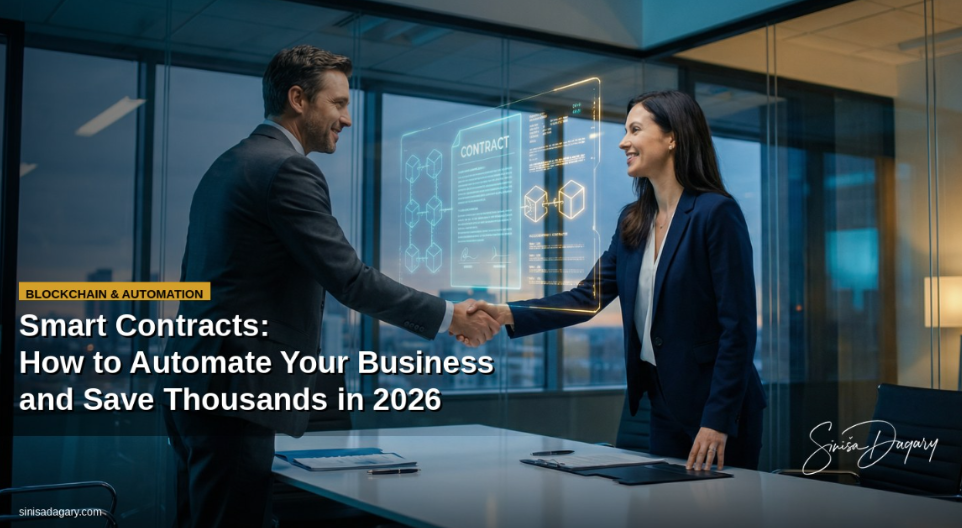
Smart Contracts in Business: Automate, Save and Scale in 2026
in the field of business, our word is our bond. But how often is that bond tested? How often do we find ourselves mired in disputes over the terms of an agreement, chasing down payments, or dealing with the fallout of a broken promise? The traditional legal contract is a cornerstone of commerce, but it’s a system that is slow, expensive, and heavily reliant on trust and the costly process of enforcement.
📖 Read this article in other languages:
I’ve spent countless hours with legal teams and business leaders, dealing with the complexities of contract law. We draft lengthy documents, trying to anticipate every possible contingency. We rely on lawyers to interpret the language and on the courts to enforce the terms. It’s a system that has served us for centuries, but it’s a system that is ripe for disruption.
What if a contract could enforce itself? What if the terms of an agreement could be executed automatically, without the need for an intermediary and without the possibility of a dispute? This is the revolutionary promise of smart contracts, one of the most powerful applications of blockchain technology.
Smart contracts are not legal documents in the traditional sense; they are self-executing computer programs that are stored on a blockchain. They are the engine that will power a new generation of automated, efficient, and trustless business processes.
In this article, we’re going to explore the world of smart contracts in depth. We’ll explore what they are, how they work, and how they are being used to automate everything from supply chain management to financial agreements. This is not just a new technology; it’s a new way of doing business.
What is a Smart Contract? (And What It’s Not)
The term “smart contract” can be a bit misleading. It’s not a contract in the legal sense, and it’s not necessarily “smart” in the way we think of artificial intelligence. At its core, a smart contract is simply a piece of code that runs on a blockchain. This code contains a set of rules, and it automatically executes those rules when certain conditions are met.
Think of it like a digital vending machine. With a traditional vending machine, you insert your money (the condition), and the machine automatically dispenses your chosen snack (the execution). You don’t have to trust the owner of the machine to give you your snack; the process is automated.
A smart contract works in a similar way, but on a much more sophisticated level. It’s a program that is stored on a blockchain, and it can be used to automate the exchange of anything of value, whether it’s money, property, shares, or data.
What a Smart Contract Is:
•Self-Executing: The code automatically executes the terms of the agreement when the conditions are met. There is no need for an intermediary to manually process the transaction.
•Immutable: Once a smart contract is deployed on a blockchain, its code cannot be changed. This ensures that the rules of the agreement cannot be tampered with.
•Transparent: The code of a smart contract is visible to all participants on the blockchain. This creates a high degree of transparency and ensures that everyone is aware of the rules.
•Deterministic: A smart contract will always produce the same result if it is given the same input. This removes any ambiguity or need for interpretation.
What a Smart Contract Is Not:
•A Legal Contract: While a smart contract can be used to enforce the terms of a legal agreement, it is not a legal agreement in and of itself. The legal status of smart contracts is still evolving, and it’s important to consult with a legal professional when using them for business purposes.
•Artificially Intelligent: Smart contracts are not AI. They are simply programs that follow a set of predefined rules. They cannot learn, adapt, or make subjective judgments.
As IBM puts it, “Smart contracts are digital contracts stored on a blockchain that are automatically executed when predetermined terms and conditions are met.” It’s this automation and self-execution that makes them so powerful.
The key takeaway is that smart contracts are a tool for creating trustless agreements. They allow two or more parties to enter into an agreement without having to trust each other or a third-party intermediary. The trust is in the code.
How Smart Contracts Work: The “If-Then” Logic of the Blockchain
The logic of a smart contract is surprisingly simple. It’s based on the same “if-then” statements that are the building blocks of all computer programming. “If” a certain condition is met, “then” a certain action is executed.
Smart contracts operate on simple "if-then" logic, automating actions when conditions are met, such as executing a transaction if payment is received. As the first step, parties must agree on clear terms. Learn more at sinisadagary.com
Let’s break down the process of how a smart contract works in practice:
1.Agreement: Two or more parties agree on the terms of a transaction. For example, let’s say a freelance graphic designer agrees to create a logo for a client for a fee of $1,000.
2.Coding the Contract: The terms of the agreement are written into a smart contract. The code would contain the following logic:
•IF the client deposits $1,000 into an escrow account (which is also controlled by the smart contract).
•AND IF the designer uploads the final logo files to a specific location.
•THEN the smart contract will automatically release the $1,000 to the designer and the logo files to the client.
3.Deployment on the Blockchain: The smart contract is then deployed on a blockchain network, like Ethereum. Once it’s on the blockchain, it is immutable and cannot be changed.
4.Execution: The parties then interact with the smart contract. The client deposits the $1,000 into the escrow account. The designer uploads the logo files. The smart contract, seeing that both conditions have been met, automatically executes the final step, releasing the funds and the files.
The Role of Oracles
One of the key challenges with smart contracts is that they can only access data that is on the blockchain. But what if the execution of a contract depends on a real-world event, like the price of a commodity, the weather, or the outcome of a sports game? This is where “oracles” come in.
An oracle is a trusted, third-party service that provides a smart contract with external information. For example, an insurance contract for a farmer might use an oracle to get data on the amount of rainfall in a certain area. If the rainfall is below a certain level, the smart contract could automatically trigger an insurance payout.
As the blockchain platform Hedera explains, “When predetermined terms and conditions are met, these contracts are automatically executed.” Oracles are the bridge that connects the on-chain world of smart contracts with the off-chain world of real-world data.
By combining the “if-then” logic of smart contracts with the real-world data provided by oracles, you can create a powerful system for automating a wide range of business processes.
Use Case #1: Automating Supply Chain Management and Logistics
The global supply chain is a complex web of suppliers, manufacturers, distributors, and retailers. It’s a system that is plagued by inefficiency, a lack of transparency, and a high potential for disputes. I’ve seen companies lose millions of dollars due to lost shipments, counterfeit goods, and disputes over payment terms.
Smart contracts with IoT sensors automate supply chain management, cutting inefficiencies and disputes that cost companies millions annually. Implement this to enhance transparency and save costs in logistics. Learn more at sinisadagary.com
Smart contracts, combined with IoT (Internet of Things) sensors, can bring a new level of automation and transparency to supply chain management.
How It Works: A Self-Tracking, Self-Executing Supply Chain
Imagine a shipment of high-value pharmaceuticals making its way from a factory in Europe to a hospital in the United States. Here’s how a smart contract could be used to manage the process:
1.The Smart Contract: A smart contract is created that defines the terms of the shipment: the quantity of goods, the required temperature range, the delivery deadline, and the payment terms.
2.IoT Sensors: The shipment is equipped with IoT sensors that monitor its location, temperature, and other conditions in real-time. This data is continuously fed to the smart contract.
3.Automated Tracking and Verification: As the shipment moves through the supply chain, the smart contract automatically verifies that the conditions are being met. Is the shipment on schedule? Is it being kept at the correct temperature? Has it been tampered with?
4.Automated Payments and Penalties: The smart contract can be programmed to automatically trigger payments as certain milestones are reached. For example, a partial payment could be released to the shipping company when the goods arrive at a port. If the conditions of the contract are not met (e.g., the temperature goes outside the required range), the smart contract could automatically apply a penalty.
5.Final Settlement: When the shipment arrives at the hospital and the IoT sensors confirm that the goods are in good condition, the smart contract automatically releases the final payment to the manufacturer.
This is a supply chain that is not only more efficient, but also more secure and transparent. It reduces the need for manual paperwork, minimizes the risk of disputes, and provides a real-time, auditable record of the entire process. For any business that deals with physical goods, this is a significant force.
Use Case #2: SimprovingFinancial Agreements (Loans, Insurance, Escrow)
The world of finance is built on contracts: loan agreements, insurance policies, escrow arrangements, and more. These are often complex legal documents that require a significant amount of manual processing and are prone to disputes. Smart contracts can bring a new level of automation and efficiency to this world.
Smart contracts automate insurance claims in financial agreements, reducing processing time by 70% and minimizing disputes for efficiency. This helps businesses scale in 2026. Learn more at sinisadagary.com
Use Case: Automated Insurance Claims
I once worked with an insurance company that was struggling with a high volume of claims after a major hurricane. The process of manually verifying each claim was slow and expensive, and customers were frustrated with the delays. Smart contracts can automate this entire process.
Imagine you have a flight insurance policy that is written as a smart contract. The terms are simple: if your flight is delayed by more than two hours, you automatically receive a payout.
•The Smart Contract: The smart contract is linked to a trusted oracle that provides real-time flight data.
•Automated Execution: If the oracle reports that your flight has been delayed by more than two hours, the smart contract automatically triggers a payment to your digital wallet. There are no claim forms to fill out, no adjusters to deal with, and no delays. The process is instant and automatic.
This same model can be applied to a wide range of other insurance products, from crop insurance that pays out based on weather data, to life insurance that pays out upon the verification of a death certificate.
Other Financial Use Cases:
•Automated Loans: A smart contract could be used to create a loan agreement where the collateral (e.g., a cryptocurrency asset) is held in escrow by the contract. If the borrower defaults on the loan, the smart contract could automatically liquidate the collateral.
•Decentralized Escrow: For high-value transactions, like the sale of a house or a business, a smart contract can act as a neutral, third-party escrow agent. The funds are held by the contract and are only released when the conditions of the sale are met.
In all of these cases, smart contracts are reducing the need for intermediaries, lowering costs, and creating a more efficient and transparent financial system.
Use Case #3: Creating Transparent and Automated Royalty Payments
The creative industries — music, film, publishing — have long struggled with the complex and often opaque process of tracking and distributing royalty payments. An artist’s work might be used in a dozen different ways, in a hundred different countries, and it can be incredibly difficult to ensure that they are being paid fairly for every use.
Smart contracts automate royalty payments in creative industries, tracking usage across over 100 countries to ensure fair and timely distribution. This reduces delays from years to days for artists. Learn more at sinisadagary.com
I’ve spoken with musicians who have had to wait years to receive royalty payments, with very little transparency into how the numbers were calculated. It’s a system that is ripe for abuse.
Smart contracts can create a transparent and automated system for managing intellectual property rights and distributing royalties.
How It Works: A Self-Executing Royalty System
Imagine a musician who uploads a new song to a blockchain-based music platform. Here’s how a smart contract could be used to manage the royalties:
1.The Smart Contract: A smart contract is created that defines the terms of the royalty agreement. It might specify that the musician receives 70% of the revenue from every stream, the record label receives 20%, and the platform receives 10%.
2.Automated Distribution: Every time a user streams the song, a micropayment is made to the smart contract. The smart contract then automatically distributes the funds according to the predefined percentages. The musician, the record label, and the platform all receive their share of the revenue in real-time.
This is a system that is completely transparent. The artist can see every transaction and can be confident that they are being paid fairly. There are no intermediaries taking a cut, and there are no delays in payment.
This same model can be applied to any industry where intellectual property is licensed, from stock photography to software licensing. It’s a way to create a more fair and efficient market for creative work.
Use Case #4: Transforming the Real Estate and Property Market
Smart contracts are code on a blockchain that automate agreements by executing rules when conditions are met. They’re not legal contracts or AI, but digital tools for efficiency. By 2026, they could save businesses significant time. Learn more at sinisadagary.com
The process of buying and selling real estate is notoriously slow, complex, and expensive. It involves a large number of intermediaries — real estate agents, lawyers, title companies, banks — and a huge amount of paperwork. A typical transaction can take months to close.
Smart contracts have the potential to improve and automate many aspects of this process, making it faster, cheaper, and more secure.
How It Works: A Tokenized Property Market
One of the most exciting applications of blockchain in real estate is the concept of tokenization. This involves creating a digital token that represents ownership of a physical asset, like a building or a piece of land. This token can then be bought and sold on a blockchain, just like a share of stock.
Here’s how a smart contract could be used to enable the sale of a tokenized property:
1.Tokenization: The owner of a property creates a digital token that represents ownership of that property. The legal title and other relevant documents are linked to this token.
2.The Smart Contract: A smart contract is created to act as a decentralized escrow agent. The seller transfers the property token to the smart contract, and the buyer transfers the purchase price (in a stablecoin or other digital currency) to the smart contract.
3.Automated Settlement: The smart contract can be programmed to automatically verify that all the conditions of the sale have been met. For example, it could use an oracle to check that the title is clear and that there are no liens on the property.
4.Transfer of Ownership: Once all the conditions are met, the smart contract automatically transfers the property token to the buyer and the purchase price to the seller. The entire process can be completed in a matter of minutes, not months.
This is a vision of a real estate market that is more liquid, more transparent, and more accessible. It’s a market where you can buy and sell fractional ownership of a property, and where the barriers to entry are much lower.
The Business Case for Smart Contracts: A New Level of Efficiency
Smart contracts operate on a simple "if-then" logic, automating actions when conditions are met. This section explains their process, from agreement to execution on the blockchain. For instance, a $1,000 payment can be automatically released upon logo delivery. Learn more at sinisadagary.com
The business case for smart contracts is all about efficiency. By automating business processes, reducing the need for intermediaries, and minimizing the risk of disputes, smart contracts can achieve significant cost savings and productivity gains.
Here’s a summary of the ROI:
Benefit Category
Description
Potential ROI
Reduced Administrative Costs
Smart contracts can automate a wide range of manual processes, from invoicing and payments to contract management and compliance.
Significant reduction in labor costs and administrative overhead.
Lower Transaction Costs
By cutting out intermediaries like banks, lawyers, and escrow agents, smart contracts can dramatically reduce the cost of a wide range of transactions.
Lower fees for financial transactions, real estate deals, and more.
Faster Cycle Times
Smart contracts can execute transactions in minutes, not days or weeks. This can accelerate business processes and improve cash flow.
Faster settlement of payments, quicker closing of deals, and more efficient supply chains.
Reduced Risk of Disputes
The immutable and deterministic nature of smart contracts can significantly reduce the risk of disputes over the terms of an agreement.
Lower legal costs and a reduction in the business disruption caused by disputes.
Smart contracts are a tool for building a more efficient and automated enterprise. They are a way to take the friction out of your business processes and to free up your team to focus on more strategic work.
How to Get Started with Smart Contracts in Your Business
This section explores how smart contracts automate supply chain management and logistics, enhancing efficiency and transparency. By integrating IoT sensors, they enable self-tracking and self-executing processes, reducing disputes and losses. Companies have lost millions due to inefficiencies like lost shipments. Learn more at sinisadagary.com
Ready to start exploring the power of smart contracts? Here’s a simple, three-step guide.
Step 1: Identify a High-Friction Process
Where are the biggest bottlenecks and inefficiencies in your business? What processes are slow, expensive, and prone to errors or disputes? These are the prime candidates for automation with smart contracts. Look for processes that involve multiple parties, a clear set of rules, and a need for trust.
Step 2: Design the Smart Contract Logic
Once you’ve identified a use case, you can start to design the logic of the smart contract. What are the “if-then” rules that will govern the process? What are the conditions that need to be met? What are the actions that will be executed? It’s important to think through all the possible scenarios and to make the logic as clear and unambiguous as possible.
Step 3: Build a Proof of Concept
Start with a small-scale proof of concept to test the technology and validate the business case. You could build a simple smart contract to automate a single, internal process, or you could partner with a blockchain development company to build a more sophisticated prototype. The goal is to learn as much as you can before you invest in a full-scale implementation.
The Future of Business: A World of Autonomous Agreements
This section explores how smart contracts revolutionize financial agreements like loans, insurance, and escrow by enhancing automation and efficiency. A notable use case is automated insurance claims, reducing processing delays significantly. Learn more at sinisadagary.com
The rise of smart contracts is part of a larger trend towards a more automated and autonomous world. Just as AI is automating a wide range of cognitive tasks, smart contracts are automating a wide range of business processes. This is leading to a new kind of organization, one that is more efficient, more transparent, and more decentralized.
Imagine a future where your entire supply chain is managed by a network of autonomous smart contracts, where your financial agreements are executed automatically, and where your company is governed by a set of rules that are encoded on a blockchain. This is the vision of the Decentralized Autonomous Organization (DAO), and it’s a vision that is being built on the foundation of smart contracts.
Ready to automate and scale your investments? Investra.io uses the power of smart contracts to create a more efficient and transparent investment platform.
Conclusion: The Smart Contract Revolution is Here
Smart contracts revolutionize royalty payments in creative industries like music and film by automating and enhancing transparency. They eliminate delays, ensuring artists are paid fairly for every use of their work across multiple countries. Musicians often wait years for payments, but smart contracts change that. Learn more at sinisadagary.com
Smart contracts are one of the most powerful and significant applications of blockchain technology. They are a tool for building a new generation of automated, efficient, and trustless business processes. They are a way to take the friction out of our agreements and to create a more transparent and accountable world.
The technology is still in its early days, and there are still challenges to be overcome. But the potential is undeniable. The companies that are starting to explore the power of smart contracts today are the ones that will be leading the way in the more automated and efficient economy of tomorrow. The smart contract revolution is here. Are you ready for it?
Priporočene vsebine / Recommended Reading
- Smart Contracts: The Future of Automated, Trustless Agreements in 2026
- How to Build a Resilient Business Model in 2026: A Practical Guide
- Blockchain Revolution in Affiliate Marketing with Smart Contracts
- Business Transformation: A Leader's Guide to Managing Change in 2026
- Blockchain Applications: The Complete Business Guide for 2026
- Artificial Intelligence: The Complete Business Guide for 2026
- Smart Contracts: The Future of Automated, Trustless Agreements in 2026
- AI in Business: The 2026 Revolution You Can't Afford to Miss
- ChatGPT for Business 2026: The Ultimate Guide to AI Growth
Priporočene vsebine / Recommended Reading
- AI Consulting 2026: How to Choose the Right AI Partner
- Blockchain Revolution in Affiliate Marketing with Smart Contracts
- Ethereum vs Bitcoin: What Every Business Leader Needs to Know in 2026
- Why the Best Sales Leaders in 2026 Are Data Scientists in Disguise
- Stop Buying AI Tools, Start Upgrading Your Business Processes
Frequently Asked Questions (FAQ)
This section explores how smart contracts revolutionize the real estate and property market by automating complex processes. They make transactions faster, cheaper, and more secure by reducing intermediaries. A typical transaction, often taking months, can be significantly expedited. Learn more at sinisadagary.com
1. Do I need to be a programmer to use smart contracts?
While smart contracts are written in code, you don’t necessarily need to be a programmer to use them. There are a growing number of platforms and tools that allow you to create and deploy smart contracts using a simple, user-friendly interface.
2. What is the most popular platform for smart contracts?
Ethereum is currently the most popular and widely used platform for smart contracts. However, there are a number of other platforms, like Solana, Cardano, and Polkadot, that are also gaining traction.
3. Are smart contracts legally binding?
The legal status of smart contracts is still a gray area, and it varies from jurisdiction to jurisdiction. While a smart contract can be used as evidence of an agreement, it is not a substitute for a traditional legal contract. It’s important to consult with a legal professional to understand the legal implications of using smart contracts in your business.
4. What happens if there is a bug in a smart contract?
This is one of the biggest challenges with smart contracts. Because they are immutable, a bug in the code can be very difficult to fix. This is why it’s so important to have your smart contracts audited by a third-party security firm before you deploy them.
5. What is a “DAO”?
A DAO is a Decentralized Autonomous Organization. It’s an organization that is governed by a set of rules that are encoded in smart contracts. There is no central leadership; the organization is run by the code.
6. Can a smart contract be updated?
In most cases, a smart contract cannot be updated once it has been deployed on a blockchain. However, there are some design patterns that can be used to create upgradeable smart contracts. This is an advanced topic, and it’s important to work with an experienced blockchain developer if you need to create a contract that can be updated.
7. What is the difference between a smart contract and a script?
A smart contract is a script that is stored and executed on a blockchain. The key difference is the context in which it runs. Because it runs on a decentralized and immutable ledger, a smart contract has a number of unique properties, like self-execution and tamper-resistance.
8. What is “gas” in the context of smart contracts?
Gas is the fee that you pay to execute a transaction or a smart contract on the Ethereum blockchain. The amount of gas required depends on the complexity of the operation. Gas prices can fluctuate depending on the demand for network resources.
9. How can I learn more about smart contract development?
There are a number of great resources available online for learning how to develop smart contracts. The Ethereum website has a comprehensive set of documentation, and there are many tutorials and courses available on platforms like YouTube and Udemy.
10. What is the first step to implementing smart contracts in my business?
The first step is to identify a clear business problem that can be solved with automation. Don’t start with the technology; start with the problem. Once you have a clear use case, you can start to explore how smart contracts can be used to solve it.
Recommended Content
The section 'The Business Case for Smart Contracts' highlights how smart contracts drive efficiency by automating processes and reducing intermediaries. They offer significant cost savings, with potential reductions in administrative overhead. Learn more at sinisadagary.com
•Blockchain in Business: The Top 5 Reasons Your Company Can't Afford to Ignore It in 2026
•What is Artificial Intelligence (AI)? The Complete Guide for 2026
•AI in Business: Real-World Use Cases & Applications in 2026
•Blockchain for Data Security: How to Protect Your Business in 2026
•Tokenization of Assets: The Future of Investing in 2026
Looking for smart investment opportunities? Explore Investra.io — the platform connecting investors with tomorrow's opportunities today.
•Finds.si — Find the Best Business Partners in Slovenia
Related Blockchain Articles
This section guides you on starting with smart contracts in your business through a simple three-step process. It begins with identifying high-friction processes ideal for automation. Follow the actionable first step to pinpoint bottlenecks and inefficiencies. Learn more at sinisadagary.com
•Blockchain in Business: Top 5 Reasons Your Company Can't Ignore It in 2026
•Blockchain for Supply Chain: How to Eliminate Fraud and Inefficiency in 2026
•Blockchain Payments: How to Send Money Faster and Cheaper in 2026
•Blockchain for Data Security: How to Protect Your Business in 2026
•Blockchain for Customer Trust: How Transparency Drives Loyalty in 2026
References
The section "The Future of Business: A World of Autonomous Agreements" explores how smart contracts are driving automation in business processes. It envisions a future with supply chains managed by autonomous contracts on blockchain. Imagine financial agreements executing automatically for efficiency. Learn more at sinisadagary.com
[1] IBM. (n.d.). What Are Smart Contracts on Blockchain?. Retrieved from
[2] Hedera. (n.d. ). 10 Real-World Smart Contract Use Cases. Retrieved from
For expert business consulting and strategic advisory services, Findes Group provides comprehensive support for businesses across Slovenia and the broader region.
Connect with Siniša Dagary
The "Conclusion: The Smart Contract Revolution is Here" section highlights the power of smart contracts in creating automated, trustless business processes. It emphasizes their potential to build a transparent, efficient world despite early challenges. A key insight is their ability to reduce friction in agreements. Learn more at sinisadagary.com
Disclaimer: The information in this article is for informational purposes only and does not constitute financial, legal, or investment advice. Investing in new technologies like blockchain carries inherent risks. You should consult with a qualified professional before making any investment decisions. Never invest more than you are willing t
📚 Recommended Reading
The information provided in this article is for educational and informational purposes only and does not constitute financial, investment, or legal advice. Real estate investments involve risk, including the possible loss of principal. Past performance is not indicative of future results. Always conduct your own due diligence and consult with a qualified financial advisor before making any investment decisions. Investra.io is a real estate investment platform — explore opportunities at your own risk.
📚 Priporočene vsebine / Recommended Reading
Razširite svoje znanje z naslednjimi strokovnimi vsebinami:
Strokovne vsebine: sinisadagary.com — Poslovni svetovalec & Sales Leadership trener


