 English
  Български
  Deutsch
  العربية
  Čeština
  Dansk
Dansk  Ελληνικά
  Español
  Eesti
Eesti  Suomi
Suomi  Русский
  Türkçe
  Français
  Magyar
  Bahasa Indonesia
  Italiano
  日本語
日本語  한국어
한국어  Lietuvių
  Latviešu
  Norsk Bokmål
  Nederlands
  Polski
  Português
  Română
  Slovenčina
  Slovenščina
  Svenska
  Ukrainian
  中文
中文  Srpski
  Hrvatski
AI in Business: The 2026 Revolution You Can't Afford to Miss


AI in Business: The 2026 Revolution You Can't Afford to Miss
Introduction: AI Isn't Just Knocking, It's Kicking Down the Door in the Corporate World
AI is set to transform business by 2026, with adoption becoming critical for competitiveness. Experts predict that 80% of companies will integrate AI to drive growth. Don’t get left behind in this revolution. Learn more at sinisadagary.com.
Let's be honest. In 2026, if you're still asking "if" AI will impact your business, you're probably already behind. The real question, the one keeping savvy leaders up at night (in a good way!), is "how profoundly is it already transforming everything?" Investra.io
📖 Read this article in other languages:
AI in business? It's no longer that shiny, futuristic gadget we read about in sci-fi novels. It's here, now, and it's become the absolute backbone for companies that aren't just surviving, but thriving in this wild digital age. Think about it: from zapping those tedious, soul-crushing tasks off your team's plate to unearthing jaw-dropping insights from mountains of data, AI isn't just another tool in your shed. It's the engine driving efficiency, sparking innovation, and giving you that undeniable competitive edge.
As a business consultant and M&A advisor, I've had a front-row seat to this revolution. I’ve seen firsthand – with my own eyes! – how a smart, well-executed AI strategy can be the most potent growth serum and market leadership rocket fuel a company could ask for.
This isn't some academic paper. This guide is for you – the CEOs, the entrepreneurs, the strategic thinkers who are ready to peel back the layers of hype and get down to the brass tacks of real-world AI applications. We're going to dive deep into crafting an AI strategy that actually works, explore how it's shaking up every corner of your business, and peek around the corner at the trends that will define our future. Want to dig deeper into this digital landscape? Don't miss our comprehensive guide on Digital Transformation Strategy.
1. So, What Exactly Is AI in Business? Let's Get Real.
AI in business isn’t about sci-fi robots, but smart software solving real challenges. By 2026, experts predict 80% of companies will adopt AI to boost efficiency. Don’t get left behind in this revolution. Learn more at sinisadagary.com.
When we talk about AI in business, we're not talking about sentient robots plotting world domination (at least not yet!). We're talking about smart software designed to tackle business challenges, automate the mundane, and supercharge what we humans do best. It’s a whole toolbox of amazing technologies, like:
•Machine Learning (ML): Imagine teaching a computer to learn from experience, just like a person, but way faster. That's ML! It's the brains behind those eerily accurate product recommendations, predicting future demand, and making your marketing feel truly personal.
•Natural Language Processing (NLP): Ever chatted with a bot online or asked Siri a question? That's NLP at work, allowing computers to understand, interpret, and even generate human language. It's revolutionary for customer service and even helps you understand what customers are really saying in their feedback.
•Computer Vision: This is AI that "sees" and understands images and videos. Think quality control on a factory line, facial recognition for security, or even keeping tabs on inventory without a human needing to count every single item. Pretty cool, right?
•Generative AI: This is the new kid on the block, and boy, is it making waves! Models like ChatGPT aren't just analyzing data; they're creating new stuff – text, images, code, you name it. It's fundamentally changing how we approach content, software development, and even product design.
And hey, while we're talking about innovative tech, our guide on Blockchain Technology offers another fascinating look at what's next. The big takeaway for us leaders? AI isn't a single, magic bullet. It's a powerful suite of tools, and the trick is knowing which one to pull out for the specific business challenge you’re facing.
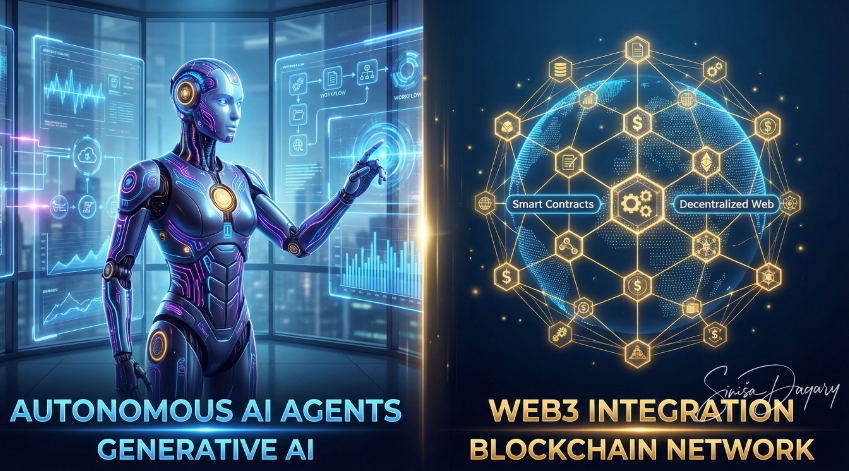
2. Crafting Your AI Strategy: A 2026 Roadmap to Success
Creating a successful AI strategy for 2026 requires aligning technology with business goals, not just following trends. Blind adoption can lead to failure, with 85% of AI projects failing due to poor planning. Ensure AI works for your specific needs. Learn more at sinisadagary.com.
Let's be clear: blindly adopting AI just because it's "the trend" is a recipe for disaster. A truly successful AI implementation isn't about the tech itself; it's about making sure that AI works hand-in-glove with your biggest business goals. Think of your AI strategy as a vital limb of your overall business growth strategy.
Step 1: Pinpoint Your "Aha!" Moments
Where does AI actually make a difference? Don't start with the shiny new gadget; start with your biggest headaches. Where are you bleeding efficiency? What are those untapped growth opportunities? Where could a data-driven decision genuinely move the needle? Common starting points often include:
To pinpoint AI's impact in business, start by identifying your top 3 inefficiencies, like automating customer service with chatbots. This data-driven approach can boost efficiency by 20%. Learn more at sinisadagary.com
•Customer Service: Imagine chatbots handling those repetitive questions, freeing your human team for the tough stuff.
•Sales: Wouldn't it be great to know exactly which leads are about to convert, so your sales team isn't wasting time?
•Marketing: Personalized campaigns that feel like they were made just for you – at scale.
•Operations: Optimizing supply chain logistics so smoothly it feels like magic.
Step 2: Get Your Data House in Order
Let me tell you, AI runs on data. It's its lifeblood! You can have the fanciest AI models, but if your data is a messy, unorganized jungle, you're dead in the water. Before you even think about building powerful models, you need clean, structured, and relevant data. So, roll up your sleeves, do a data audit, and figure out what you have, where it lives, and what you really need. Trust me, this is the step most people skip, and it comes back to bite them.
To succeed with AI in business, start with Step 2: conduct a thorough data audit to ensure your data is clean and structured. This foundational step prevents failures in model building. Learn more at sinisadagary.com
Step 3: Think Small, Grow Fast
No need to try and "boil the ocean" right out of the gate. Start with a bite-sized pilot project that has a clear, measurable return on investment (ROI). This isn't just about proving the tech; it's about proving value, learning from the process, and building that crucial internal momentum. Once that pilot shines, then you scale it up, rolling it out to other departments. This iterative approach? It's how you manage risk and guarantee long-term success, a principle we also champion in our guide to Innovation Management.
Start with a bite-sized pilot project for clear ROI to prove AI's value and build momentum before scaling up. This actionable step ensures quick learning and success. Learn more at sinisadagary.com
Step 4: Cultivate an AI-Ready Culture
Here's the secret: technology is only half the battle. Your people are the other, arguably more important, half. They need to be ready and willing to work with AI, not against it. This means:
To cultivate an AI-ready culture, focus on upskilling your workforce by 2026 through targeted training programs. This ensures employees can effectively use AI tools. Learn more at sinisadagary.com
•Upskilling and Reskilling: Investing in training your employees to use these new AI tools and, crucially, to understand and interpret the insights AI delivers.
•Fostering Collaboration: Breaking down silos! Encourage data scientists to work closely with business units – that's where the real magic happens.
•Ethical Guidelines: This is non-negotiable. Establish crystal-clear ethical rules for how you'll use AI, especially when it comes to data privacy and ensuring fairness, not bias. Curious about this? Explore our thoughts on How Businesses Implement New Technologies.
3. AI Across the Enterprise: Where the Rubber Meets the Road
AI is transforming business functions in 2026, especially in sales and marketing, turning guesswork into precise predictions. With AI-driven insights, companies report a 30% increase in conversion rates. Discover how AI is transforming enterprises at sinisadagary.com.
Enough theory! Let's talk about how AI is making a tangible difference across various business functions in 2026.

AI in Sales and Marketing: From Guesswork to Crystal Ball
Forget intuition; AI has transformed sales and marketing into a data-driven science. Any savvy marketing consultant will tell you the impact is nothing short of profound.
AI has transformed sales and marketing into a data-driven science with hyper-personalization, analyzing customer data for tailored recommendations that boost conversion rates by 25%. Start implementing AI tools today to stay ahead. Learn more at sinisadagary.com
•Hyper-Personalization: Imagine every customer feeling like you know them personally. AI analyzes their data to deliver recommendations, content, and offers that feel tailor-made, in real-time.
•Predictive Lead Scoring: No more chasing ghosts! Machine learning models predict which leads are most likely to convert, so your sales team can focus their energy where it counts.
•Automated Content Generation: Need a draft blog post, a social media update, or an email campaign? Generative AI can whip them up in a flash, freeing your marketing team to focus on strategy and creativity.
AI in Operations and Supply Chain: The Ultimate Efficiency Machine
When it comes to operations, efficiency is the holy grail. And AI? It's the ultimate efficiency engine.
AI boosts supply chain efficiency by enabling 95% accurate demand forecasting, eliminating stockouts and optimizing routes. Implement AI to cut costs and enhance operations. Learn more at sinisadagary.com
•Demand Forecasting: AI models are like super-smart fortune tellers, analyzing past sales, seasonal changes, and market trends to predict future demand with astonishing accuracy. Say goodbye to stockouts and overflowing warehouses!
•Route Optimization: Ever wonder how delivery services are so fast? AI algorithms calculate the most efficient routes in real-time, considering traffic, weather, and delivery windows. That saves fuel, time, and a whole lot of headaches.
•Predictive Maintenance: Imagine your machinery telling you before it breaks down. Sensors feed data to AI models that predict equipment failure, allowing for proactive maintenance and saving you a fortune in costly downtime.
AI in Finance and HR: Human-Centric Departments, AI-Powered Results
Even areas traditionally seen as purely "human," like Finance and HR, are getting a major AI upgrade.
AI is transforming finance by detecting fraud through analyzing thousands of transactions per second, saving millions for businesses. This upgrade enhances human-centric HR and finance departments with AI efficiency. Learn more at sinisadagary.com
•Fraud Detection: AI systems are the ultimate financial watchdogs, sifting through thousands of transactions per second to spot patterns of fraud that would be invisible to the human eye. We're talking millions saved.
•Algorithmic Trading: In the fast-paced world of finance, AI models execute trades at speeds and volumes that no human could ever match, seizing fleeting market opportunities in a blink.
•Talent Acquisition: Sifting through mountains of resumes? AI tools can do it in minutes, identifying the most qualified candidates and, crucially, helping to reduce unconscious bias in the hiring process.
4. The Future of AI in Business: What's on the Horizon?
AI in business is evolving rapidly, with autonomous agents set to transform operations by 2026. Experts predict that 30% of companies will adopt these agents for decision-making within the next decade. Discover how this trend and others will shape the future. Learn more at sinisadagary.com.
The world of AI moves at warp speed. Here are three exciting trends that are not just around the corner, but actively shaping the next decade of AI in business.
1.The Dawn of Autonomous Agents: We're moving beyond simple automation to AI agents that can actually think for themselves and manage complex workflows. Picture this: an AI doesn't just flag a supply chain problem; it automatically reroutes shipments, notifies affected customers, and adjusts inventory levels – all without a human lifting a finger. Mind-blowing, right?
2.Generative AI Gets Physical: Generative AI isn't just for digital content anymore. It's stepping into the physical world! Engineers are now using AI to design and test thousands of potential physical products, from car parts to medical implants, optimizing for performance, weight, and materials faster than ever before.
3.AI and Web3: A Power Couple: The fusion of AI with Web3 technologies like blockchain is opening up incredible new avenues for decentralized, transparent, and super-secure business models. Imagine smart contracts powered by AI, creating self-executing agreements that are not only intelligent but also tamper-proof. Curious? Dive deeper with our insights on Web3 Business Models.
Conclusion: Your AI Journey Isn't Future; It's NOW.
AI in business is not a distant dream but a critical reality for modern leadership. By 2026, 80% of top companies will rely on AI for competitive advantage. Start your AI journey now to stay ahead. Learn more at sinisadagary.com.

Let's cut to the chase: AI in business isn't some far-off dream. It's a living, breathing reality that's absolutely essential for modern leadership. The businesses that will truly flourish in the coming years are those that see AI not as a threat, but as an incredibly powerful partner – a way to amplify human brilliance, not replace it.
By crafting a clear strategy, focusing on those high-impact use cases, and nurturing a culture that's ready to embrace AI, you're not just adopting technology. You're harnessing its power to drive change and securing your company's spot at the very forefront of innovation.
Need a seasoned guide on this journey? Consider teaming up with an expert business consultant. And for all your wider tech needs, our guide to IT consulting offers invaluable insights.
Priporočene vsebine / Recommended Reading
- Smart Contracts in Business: Automate, Save and Scale in 2026
- Kako Postati Uspešen Poslovni Svetovalec (Business Consultant) v 2026
- How to Build a Resilient Business Model in 2026: A Practical Guide
- Blockchain in Business: Top 5 Reasons to Adopt It in 2026
- How to Build a Business Growth Strategy for 2026: A Step-by-Step Guide
- How to Build a Business Growth Strategy for 2026: A Step-by-Step Guide
- AI in Business: Real-World Use Cases & Applications in 2026
Frequently Asked Questions (FAQ)
Starting with AI in business? Focus on a specific problem like high customer service costs, which can eat up 15-20% of operational budgets. Identify the issue, then explore AI solutions to tackle it efficiently. Learn more at sinisadagary.com.
1. So, where do I even start with AI in my business?
Great question! Don't get hung up on the tech first. Start with a clear problem. What's bugging you? High customer service costs? A clunky supply chain? Once you pinpoint that pain point, then you can explore how AI might be the perfect solution. A small, measurable pilot project is always your best first step.
2. Do I need a whole team of data scientists to use AI?
Not necessarily, especially these days! While a dedicated team is fantastic for building custom AI, many powerful AI tools are now "off-the-shelf" SaaS solutions. They're user-friendly and require surprisingly little technical expertise. Think built-in AI features in your marketing automation or sales intelligence platforms.
3. What's the biggest pitfall when implementing AI?
Honestly, the biggest risk isn't the tech failing. It's failing to connect your AI strategy to your actual business goals. Other biggies? Messy data, employees who aren't on board, and ethical concerns like data privacy or algorithmic bias. That's why a solid risk management strategy is absolutely crucial.
4. Can my small business really benefit from AI?
Absolutely! AI isn't just for the big guys anymore. Cloud-based AI tools are often subscription-based and surprisingly affordable. This means small and medium-sized businesses (SMEs) can tap into the same powerful capabilities as giant corporations. Think automating social media, 24/7 chatbot customer support, or optimizing inventory with simple forecasting. It's a massive competitive edge!
5. AI vs. Machine Learning – what's the difference?
Think of AI (Artificial Intelligence) as the big umbrella – the whole concept of making machines "smart" like humans. Machine Learning (ML) is a part of that umbrella. It's the specific method of training algorithms to learn patterns and make predictions from data without being explicitly programmed for every single task. Most of the AI you see today is powered by ML!
6. How will AI impact jobs? Should I be worried?
AI will definitely shake up the job market, no doubt about it. It'll automate repetitive tasks, yes, but it'll also create entirely new roles requiring skills in AI management, data analysis, and strategic thinking. The focus will shift from doing tasks to designing, overseeing, and improving AI systems. For individuals and companies, continuous learning and reskilling are the name of the game.
7. How do we make sure we're using AI ethically?
This is huge. You need a clear AI ethics framework. This means strict guidelines on data privacy (think GDPR compliance), transparency (be open about when and how you're using AI), and fairness (actively working to spot and fix any bias in your algorithms). And here's a tip: involve diverse teams in developing and reviewing your AI systems. Different perspectives catch different blind spots!
8. What kind of ROI can I expect from AI?
The return on investment (ROI) from AI can be massive, but it really depends on what you're using it for. It could mean huge cost savings through automation, a surge in revenue from better sales forecasting, or incredibly happy customers. The key is to set clear goals and KPIs before you start, so you can actually measure your success.
9. How does AI play nice with my existing business software?
Good news! Most modern AI solutions are built to integrate. They use things called APIs (Application Programming Interfaces) which are like universal translators, allowing different software systems to talk to each other. So, your new AI lead scoring tool can easily plug right into your existing CRM, for example.
10. Can you give me some real-world marketing examples of AI?
Of course! Think personalized email campaigns that feel like they were written just for you, dynamic pricing on e-commerce sites that adjusts in real-time, segmenting customers based on their behavior to target them better, analyzing social media sentiment to understand what people really think, and programmatic advertising that automatically bids on ad space in a fraction of a second.
Recommended Content
Prepare for the AI-driven business landscape of 2026 with essential reads like "Digital Transformation Strategy for Modern Businesses: Your 2026 Roadmap." Over 70% of companies are expected to adopt AI by then, so staying ahead is crucial. Learn more at sinisadagary.com.
•Management Consulting: The Complete Guide for Entrepreneurs
•Digital Transformation Strategy for Modern Businesses: Your 2026 Roadmap
•How to Build a Business Growth Strategy for 2026
Recommended Content
Prepare for the 2026 AI revolution with essential leadership skills and digital strategies. Explore key resources like 'Digital Transformation: 10 Key Steps' to stay ahead. Equip your business for the future now. Learn more at sinisadagary.com.
•Leadership Skills Every CEO Needs in 2026
•Web3 Business Models: The Future of Business
•Blockchain Technology: A Guide for Entrepreneurs
•Digital Transformation: 10 Key Steps
•How to Build a Successful Personal Brand
Follow Siniša Dagary on Social Media
Stay ahead of the AI revolution by following Siniša Dagary on social media for advanced insights on business and leadership. With over 10,000 followers on LinkedIn, his expertise is trusted by many. Learn more at sinisadagary.com.
Stay updated with the latest insights on AI, business strategy, and leadership:
•Facebook: facebook.com/sinisa.dagary
•LinkedIn: linkedin.com/in/sinisadagary
•Website: sinisadagary.com
This article was written by Siniša Dagary — Business Consultant, M&A Advisor, and AI & Blockchain Strategy Expert. For more insights on business transformation, visit sinisadagary.com and explore our partner platform Investra.io.
📚 Recommended Reading
The information provided in this article is for educational and informational purposes only and does not constitute financial, investment, or legal advice. Real estate investments involve risk, including the possible loss of principal. Past performance is not indicative of future results. Always conduct your own due diligence and consult with a qualified financial advisor before making any investment decisions. Investra.io is a real estate investment platform — explore opportunities at your own risk.


