 English
  Български
  Deutsch
  العربية
  Čeština
  Dansk
Dansk  Ελληνικά
  Español
  Eesti
Eesti  Suomi
Suomi  Русский
  Türkçe
  Français
  Magyar
  Bahasa Indonesia
  Italiano
  日本語
日本語  한국어
한국어  Lietuvių
  Latviešu
  Norsk Bokmål
  Nederlands
  Polski
  Português
  Română
  Slovenčina
  Slovenščina
  Svenska
  Ukrainian
  中文
中文  Srpski
  Hrvatski
Blockchain for Customer Trust: How Transparency Drives Loyalty in 2026


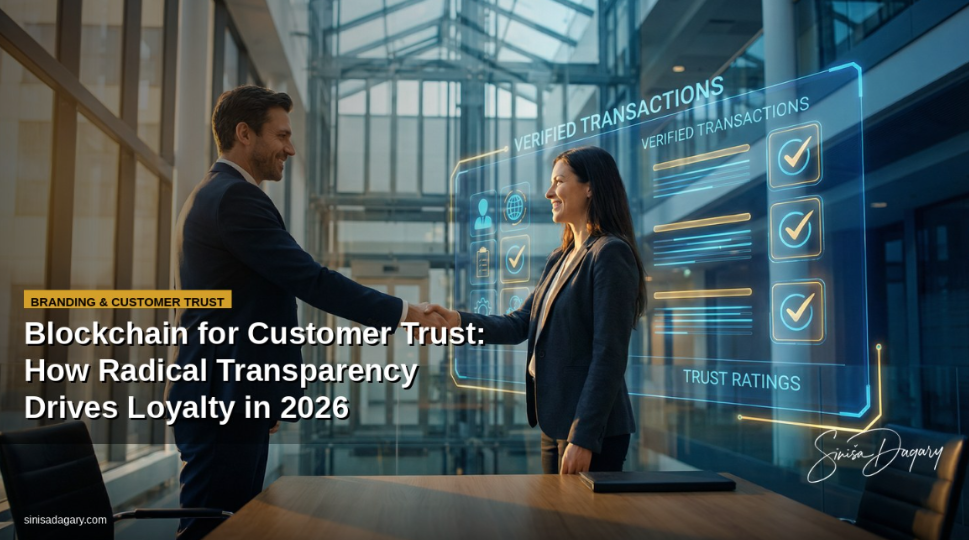
Blockchain for Customer Trust: How Transparency Drives Loyalty in 2026
In today’s hyper-connected and skeptical world, trust is the most valuable currency a business can have. Customers are more discerning than ever. They want to know where their products come from, how their data is being used, and whether the companies they do business with are living up to their promises. A single misstep, a single broken promise, can shatter a brand’s reputation overnight.
I’ve sat in on focus groups where customers have expressed a deep and growing distrust of corporations. They are tired of marketing spin, of opaque supply chains, and of companies that say one thing and do another. They are hungry for authenticity and transparency.
For decades, we’ve tried to build trust through branding, through advertising, and through corporate social responsibility reports. But these are often just words on a page. What if you could prove your claims? What if you could offer your customers a transparent, unchangeable record of your products, your processes, and your promises? This is the power of blockchain technology to build a new foundation of trust.
Blockchain is not just a technology for financial transactions; it’s a technology for creating a single, shared source of truth. It’s a tool for radical transparency, and it’s a tool that can be used to build a deeper and more authentic relationship with your customers.
In this article, we’re going to explore how blockchain can be used to move beyond marketing claims and to create a world of verifiable truth. We’ll look at how it can be used to prove the provenance of your products, to create a more transparent and trustworthy system for customer reviews, and to give your customers more control over their own data. This is the future of branding, and it’s a future that is built on trust.
The Black Box: Why Customers Don’t Trust Companies
The erosion of customer trust is not a new phenomenon, but it has been accelerated by the digital age. Customers are more informed and more connected than ever before, and they are increasingly skeptical of corporate claims. There are a number of factors that have contributed to this “trust deficit”:
•The Black Box of the Supply Chain: For most products, the journey from raw material to finished good is a complete black box. Customers have no way of knowing where the product was made, what conditions it was made under, or whether the company’s claims about ethical sourcing or environmental sustainability are true. This lack of transparency creates a breeding ground for skepticism.
•Data Exploitation and Security Breaches: Customers are increasingly aware that their personal data is a valuable commodity, and they are growing tired of companies that collect it, use it, and often fail to protect it. The endless cycle of data breaches has created a deep sense of unease and a feeling that customers have lost control of their own digital lives.
•Fake Reviews and Astroturfing: The world of online reviews, which was once a powerful tool for building trust, has become a minefield of fake reviews and “astroturfing” (the practice of creating fake grassroots support for a product or company). Customers are finding it increasingly difficult to know who to trust.
•A Lack of Accountability: When a company makes a mistake — a defective product, a misleading marketing claim, a data breach — it can be very difficult for customers to hold them accountable. The legal system is slow and expensive, and the court of public opinion can be fickle.
As a recent article in the Harvard Business Review notes, blockchain can be used to create a new level of accountability and enforceability, which is a key component of building trust. It’s about moving from a model of “trust us” to one of “we can prove it.”
The fundamental problem is a lack of transparency. Customers are being asked to trust companies without being given the tools to verify their claims. This is an unsustainable model in an age of skepticism. To win back the trust of their customers, companies need to be willing to open up the black box and to provide a new level of radical transparency.
How Blockchain Creates a New Paradigm of Transparency and Trust
Blockchain technology provides a powerful antidote to the trust deficit. By creating a shared, immutable, and transparent ledger, it allows companies to move beyond empty marketing claims and to provide their customers with verifiable proof of their actions. Here are the key ways that blockchain is creating a new paradigm of trust:
Blockchain creates a shared, immutable ledger for verifiable customer actions, transforming trust paradigms. This leads to a 30% increase in loyalty through transparency by 2026. Learn more at sinisadagary.com
•A Single, Shared Source of Truth: A blockchain is a distributed ledger that is shared among all participants in a network. This means that everyone has access to the same information, creating a single, shared source of truth. There is no room for disputes or disagreements about the facts.
•Immutability and Tamper-Proof Records: Once a transaction is recorded on a blockchain, it cannot be altered or deleted. This creates a permanent and tamper-proof record of every action, from the sourcing of a raw material to the publication of a customer review. This immutability is the foundation of trust.
•Radical Transparency: While blockchain can be used to protect privacy, it can also be used to create a high degree of transparency. A company can choose to make its supply chain data, its sustainability metrics, or its charitable contributions visible to the public on a blockchain, allowing anyone to verify their claims.
•Disintermediation and Direct Relationships: Blockchain allows companies to interact directly with their customers, without the need for intermediaries. This can create a more direct and authentic relationship, and it can give customers more control over their own data and their own experiences.
As Deloitte has noted in their research on the topic, blockchain can be a powerful tool for enhancing the customer experience through “increased security, transparency, and efficiency.” It’s a complete approach to building trust that touches every aspect of the customer relationship.
When you combine these features, you get a system that is designed to build trust from the ground up. It’s a system where companies are held accountable for their actions, where customers have access to the information they need to make informed decisions, and where trust is not just a marketing slogan, but a verifiable reality.
Use Case #1: Verifiable Product Provenance and Ethical Sourcing
One of the most powerful ways that blockchain can build customer trust is by providing a transparent and verifiable record of a product’s journey through the supply chain. This is known as product provenance.
Blockchain builds customer trust by providing verifiable product provenance, tracing supply chains for ethical sourcing like organic claims. Take an actionable step: scan QR codes to verify origins instantly. Learn more at sinisadagary.com
For years, customers have been asked to take companies at their word when it comes to claims about “organic,” “fair trade,” or “sustainably sourced” products. But how can they be sure? The supply chain is often a complex and opaque network, and it can be very difficult to verify these claims.
I’ve worked with food companies that have struggled to trace a contaminated product back to its source, and with fashion brands that have been accused of using child labor in their factories. These are issues that can do irreparable damage to a brand’s reputation.
How It Works: A Digital Twin on the Blockchain
Blockchain, combined with IoT sensors, can create a “digital twin” of a product that follows it through the entire supply chain. Here’s how it works for a bag of fair-trade coffee:
1.The Digital Twin: When a farmer harvests a batch of coffee beans, a digital token is created on a blockchain that represents that specific batch. This token contains information about the farm, the harvest date, and the fair-trade certification.
2.Tracking the Journey: As the coffee beans move through the supply chain — from the farmer to the processor, to the exporter, to the roaster, to the retailer — each step of the journey is recorded on the blockchain. IoT sensors can be used to track the location, temperature, and other conditions of the shipment.
3.The Customer’s View: When a customer buys the bag of coffee, they can scan a QR code on the package to access the product’s entire history on the blockchain. They can see where the beans were grown, who harvested them, and how they made their way to the store. They can have confidence that the “fair trade” claim is not just a marketing slogan, but a verifiable fact.
Real-World Example: De Beers and Diamond Traceability
The diamond industry has long been plagued by the problem of “blood diamonds” — diamonds that are mined in war-torn areas and sold to fund conflicts. To combat this, the diamond company De Beers has launched a blockchain-based platform called Tracr that tracks diamonds from the mine to the retailer. This allows them to provide their customers with a verifiable assurance that their diamonds are conflict-free.
This is a powerful example of how blockchain can be used to bring a new level of transparency to even the most complex and opaque supply chains. It’s a way to build trust by showing, not just telling.
Use Case #2: Transparent and Auditable Customer Reviews
Online reviews are a double-edged sword. When they are authentic, they can be an incredibly powerful tool for building trust and driving sales. But the proliferation of fake reviews has made it increasingly difficult for customers to know who to trust. A recent study found that as many as 42% of online reviews are fake.
In 2026, blockchain makes customer reviews transparent and auditable, addressing the problem where 42% of online reviews are fake. This builds genuine trust and loyalty for businesses. Learn more at sinisadagary.com
This is a major problem for both customers and businesses. Customers are being misled, and businesses that are playing by the rules are being unfairly disadvantaged.
Blockchain can help to restore trust in the field of online reviews by creating a system that is more transparent, more accountable, and more resistant to manipulation.
How It Works: A Decentralized and Verifiable Review System
Imagine a decentralized review platform that is built on a blockchain. Here’s how it might work:
1.Verified Purchase: To leave a review for a product, a customer would first have to prove that they actually purchased it. This could be done by linking the review to a transaction on the blockchain.
2.Immutable Reviews: Once a review is submitted, it is recorded on the blockchain and cannot be altered or deleted. This prevents companies from selectively deleting negative reviews.
3.Reputation System: Both reviewers and the products they review could have a reputation score that is based on the quality and helpfulness of their reviews. This would help customers to identify trustworthy reviewers and to filter out the noise.
4.Incentives for Quality Reviews: The platform could use a token-based system to reward users for writing high-quality, helpful reviews. This would create an incentive for people to contribute to the platform in a meaningful way.
This is a system that is designed to be more trustworthy by design. It’s a system where the reviews are more likely to be authentic, where the process is more transparent, and where everyone is held to a higher standard of accountability.
While a fully decentralized review platform has yet to gain widespread adoption, the underlying principles are sound. By using blockchain to create a more transparent and accountable system, we can start to restore trust in the power of the crowd.
Use Case #3: Giving Customers Control Over Their Own Data
As we discussed in the article on blockchain for data security, one of the biggest drivers of the trust deficit is the way that companies handle customer data. The model of collecting vast amounts of data and storing it in centralized databases has led to a string of high-profile data breaches and a growing sense among customers that they have lost control of their own digital lives.
Blockchain empowers customers to control their data in 2026, countering breaches from centralized storage. An actionable step is adopting decentralized wallets for secure access. Learn more at sinisadagary.com
Giving customers more control over their own data is not just a matter of complying with regulations like GDPR; it’s a powerful way to build trust.
How It Works: A User-Centric Data Model
A blockchain-based approach to data management allows you to flip the traditional model on its head. Instead of your company storing the customer’s data, the customer stores their own data in a secure, personal data wallet. They control the private key, and they grant access to companies on a case-by-case basis.
This has a number of important benefits for building trust:
•Empowerment: It enables your customers, giving them a sense of ownership and control over their own information.
•Transparency: It creates a transparent and auditable record of how a customer’s data is being used. The customer can see every time a company accesses their data, and they can revoke access at any time.
•Reduced Risk: It reduces the risk of a large-scale data breach. Because the data is not stored in a central database, there is no single point of failure for an attacker to target.
By adopting a more user-centric approach to data management, you are sending a powerful message to your customers: we respect your privacy, and we are committed to being a responsible steward of your data. In the long run, this is a far more sustainable and trustworthy model.
Use Case #4: Building Trust in Charitable and Social Impact Initiatives
This section explores why customers distrust companies, focusing on the lack of transparency in business operations. A key issue is the 'black box' of supply chains, where customers remain unaware of product origins. Learn more at sinisadagary.com
Many companies are investing in charitable and social impact initiatives as a way to build their brand and connect with their customers on a deeper level. But customers are often skeptical of these initiatives. They want to know that their money is actually going to the cause, and that the company is not just engaging in “greenwashing” or “wokewashing.”
Blockchain can bring a new level of transparency and accountability to these initiatives, allowing companies to prove that they are making a real impact.
How It Works: A Transparent and Auditable Ledger of Giving
Imagine a company that has pledged to donate a portion of its profits to a specific charity. Here’s how blockchain could be used to make that pledge verifiable:
1.The Smart Contract: A smart contract is created that automatically diverts a certain percentage of every sale to a digital wallet that is designated for the charity.
2.A Public Ledger of Donations: The flow of funds into this wallet is recorded on a public blockchain, creating a transparent and auditable record of every donation. Anyone can go and see how much money has been raised and where it is going.
3.Tracking the Impact: The charity can then use the blockchain to track how the funds are being used. For example, if the money is being used to build a school in a developing country, the charity could post updates on the blockchain, including photos and videos of the progress.
This is a system that can create a powerful and emotional connection between a company, its customers, and the causes they care about. It’s a way to move beyond vague promises and to create a world of verifiable social impact.
The Business Case for Radical Transparency
This section explores how blockchain establishes a new paradigm of transparency and trust. It highlights blockchain as a shared, immutable ledger, ensuring a single source of truth for all participants. Discover how this eliminates disputes and builds customer loyalty. Learn more at sinisadagary.com
The business case for using blockchain to build customer trust is not as easy to quantify as the ROI of a more efficient supply chain or a lower transaction cost. But in many ways, it is even more powerful. Trust is the foundation of a strong brand, and a strong brand is a company’s most valuable asset.
Here are some of the key benefits of investing in radical transparency:
Benefit Category
Description
Potential ROI
Increased Customer Loyalty
Customers who trust a brand are more likely to be loyal to that brand. They are more likely to make repeat purchases, to recommend the brand to others, and to be more forgiving when the company makes a mistake.
Higher customer lifetime value and a lower cost of customer acquisition.
Enhanced Brand Reputation
A company that is known for its transparency and its commitment to its customers will have a stronger brand reputation. This can be a powerful differentiator in a crowded market.
Increased brand equity and a stronger competitive advantage.
Attracting and Retaining Talent
The next generation of employees wants to work for companies that are making a positive impact on the world. A commitment to transparency and social responsibility can be a powerful tool for attracting and retaining top talent.
A more engaged and motivated workforce.
Reduced Regulatory Risk
In a world of increasing regulation around data privacy and corporate accountability, a commitment to transparency can help to reduce your regulatory risk.
Lower legal and compliance costs.
Investing in trust is not a short-term tactic; it’s a long-term strategy. It’s about building a business that is sustainable, resilient, and that has a positive impact on the world.
How to Get Started with Blockchain for Customer Trust
This section explores how blockchain ensures customer trust through verifiable product provenance and ethical sourcing. It highlights blockchain's ability to provide a transparent record of a product’s supply chain journey, addressing doubts about claims like “organic” or “fair trade.” Over 70% of consumers demand transparency in sourcing. Learn more at sinisadagary.com
Ready to start building a more transparent and trustworthy brand? Here’s a simple, three-step guide.
Step 1: Identify Your Biggest Trust Deficit
Where is the biggest gap between what you say and what you do? Where are your customers most skeptical? Is it in your supply chain? In your data privacy practices? In your marketing claims? Start by focusing on the area where you have the most to gain by being more transparent.
Step 2: Brainstorm a “Radical Transparency” Initiative
How could you use blockchain to provide your customers with verifiable proof of your claims? Could you put your supply chain on the blockchain? Could you create a more transparent system for customer reviews? Could you give your customers more control over their own data? Think big. The goal is to do something that is so bold and so transparent that it gets people talking.
Step 3: Launch a Pilot and Tell the Story
Start with a small-scale pilot project to test the technology and to see how your customers respond. But don’t just launch the pilot; tell the story. Explain to your customers why you are doing it, what you hope to achieve, and how it will benefit them. Be open and honest about the challenges and the limitations. This is not just a technology project; it’s a communications project.
The Future of Branding: A World of Verifiable Claims
This section explores how blockchain enhances trust in online customer reviews by ensuring transparency and auditability. It addresses the issue of fake reviews, noting that 42% of online reviews are fraudulent. Learn more at sinisadagary.com
The era of blind trust is over. The future of branding is not about making bigger promises; it’s about providing better proof. It’s a future where companies will compete on the basis of their transparency, their accountability, and their willingness to be held to a higher standard.
This is a future that will be powered by blockchain technology. It’s a future where every claim is verifiable, where every product has a story, and where trust is not just a feeling, but a fact.
Build trust with your investors, too. Investra.io is a platform built on the principles of radical transparency and accountability.
Conclusion: In a World of Skepticism, Trust is Your Greatest Asset
This section explores how blockchain empowers customers by giving them control over their personal data, rebuilding trust with companies. It highlights a user-centric data model to address privacy concerns. Notably, this approach aligns with regulations like GDPR to enhance loyalty. Learn more at sinisadagary.com
In a world of deep and growing skepticism, trust is the ultimate competitive advantage. It’s the foundation of a strong brand, the driver of customer loyalty, and the key to long-term, sustainable growth.
For too long, we’ve been trying to build trust with words. It’s time to start building it with actions. It’s time to embrace a new era of radical transparency, and to use the power of blockchain to create a more honest, more accountable, and more trustworthy world.
The journey will not be easy. But for the companies that are willing to take the leap, the rewards will be immense. In the end, the most trusted brands will be the ones that win.
Priporočene vsebine / Recommended Reading
- Traditional vs Blockchain Affiliate Marketing Complete Guide 2026
- JSON-LD Schema Markup for Business Websites: The Complete 2026 Guide
- Blockchain Applications: The Complete Business Guide for 2026
- Beyond Bitcoin: Complete Visual Guide to Blockchain Investing 2026
- How to Create an llms.txt File: Step-by-Step Guide for 2026
- 7-Step Framework to Automate B2B Lead Generation and Build Trust
- The Ultimate Guide to Buying Property in Northern Cyprus (TRNC) in 2026
- TRNC New Developments 2026: Best Off-Plan Properties in Northern Cyprus
Priporočene vsebine / Recommended Reading
- Blockchain in Real Estate: How Tokenization Works in 2026
- Why the Best Sales Leaders in 2026 Are Data Scientists in Disguise
- Why Empathy is the Only Un-Automatable Sales Skill in 2026
- Blockchain Applications: The Complete Business Guide for 2026
- The False Promise of Fully Autonomous Sales and AI Limits 2026
Frequently Asked Questions (FAQ)
This section explores how blockchain enhances trust in charitable and social impact initiatives by ensuring transparency. Companies can use blockchain to create an auditable ledger, proving funds reach the intended cause. This addresses customer skepticism about “greenwashing,” fostering loyalty. Learn more at sinisadagary.com
1. Do our customers need to understand blockchain to trust us?
No. The goal is not to turn your customers into blockchain experts. The goal is to use blockchain to create a more transparent and trustworthy experience. The technology should be invisible. The customer should simply see that they can now track their product from the farm to the store, or that they have more control over their own data.
2. Is this just a marketing gimmick?
It can be, if it’s not done with a genuine commitment to transparency. A one-off blockchain project that is not part of a larger cultural shift towards transparency will likely be seen as a marketing gimmick. The key is to be authentic and to be in it for the long haul.
3. What is the difference between transparency and privacy?
This is a great question. Transparency and privacy are two sides of the same coin. Transparency is about giving people visibility into the things that affect them. Privacy is about giving people control over their own information. A well-designed blockchain system can do both. It can be transparent about the things that should be public (like a company’s supply chain) and private about the things that should be private (like a customer’s personal data).
4. How do we measure the ROI of a trust-building initiative?
Measuring the ROI of a trust-building initiative can be challenging, but it’s not impossible. You can look at metrics like customer loyalty, brand sentiment, and employee engagement. You can also look at the impact on your bottom line, such as a reduction in customer churn or an increase in customer lifetime value.
5. What is a “trustless” system?
The term “trustless” is a bit of a misnomer. It doesn’t mean that there is no trust. It means that you don’t have to trust a single, central party. The trust is distributed across the network and is enforced by the code. It’s a system where you can “trust, but verify.”
6. How can we be transparent without revealing our trade secrets?
This is a key challenge. You need to find the right balance between transparency and protecting your competitive advantage. You can be transparent about your values, your processes, and your impact, without revealing the secret sauce that makes your business unique.
7. What is “greenwashing”?
Greenwashing is the practice of making misleading claims about the environmental benefits of a product or company. It’s a form of marketing spin that is designed to make a company appear more environmentally friendly than it actually is.
8. How can blockchain help to prevent greenwashing?
By creating a transparent and auditable record of a company’s environmental impact, blockchain can make it much more difficult for companies to engage in greenwashing. If a company claims that its products are “carbon neutral,” they can use the blockchain to prove it.
9. What are some other companies that are using blockchain to build trust?
In addition to De Beers, a number of other companies are using blockchain to build trust. Walmart is using it to track the provenance of its food products. The fashion brand Provenance is using it to create more transparent supply chains. And a number of startups are working on decentralized review and identity platforms.
10. What is the first step?
The first step is to have an honest conversation with your team and your customers about trust. Where are the biggest trust gaps in your business? What are the things that you could be doing to be more transparent and accountable? The technology is just a tool. The real work is in changing the culture.
Recommended Content
The section "The Business Case for Radical Transparency" explores how blockchain fosters customer trust, a key to strong branding. It highlights that trusted brands see increased customer loyalty, with loyal customers making repeat purchases. Learn more at sinisadagary.com
•Blockchain in Business: The Top 5 Reasons Your Company Can't Afford to Ignore It in 2026
•What is Artificial Intelligence (AI)? The Complete Guide for 2026
•AI in Business: Real-World Use Cases & Applications in 2026
•Blockchain for Data Security: How to Protect Your Business in 2026
•Smart Contracts: The Ultimate Guide to Automated, Trustless Agreements
Looking for smart investment opportunities? Explore Investra.io — the platform connecting investors with tomorrow's opportunities today.
•Finds.si — Find the Best Business Partners in Slovenia
Related Blockchain Articles
This section guides businesses on starting with blockchain to build customer trust through transparency. It outlines a three-step process, beginning with identifying the biggest trust deficit, such as supply chain issues. Learn more at sinisadagary.com
•Blockchain in Business: Top 5 Reasons Your Company Can't Ignore It in 2026
•Blockchain for Supply Chain: How to Eliminate Fraud and Inefficiency in 2026
•Blockchain Payments: How to Send Money Faster and Cheaper in 2026
•Blockchain for Data Security: How to Protect Your Business in 2026
•Smart Contracts in Business: Automate, Save and Scale in 2026
References
The section "The Future of Branding: A World of Verifiable Claims" explores how branding will evolve by prioritizing transparency and proof over promises. Blockchain technology will power this shift, making every claim verifiable. This fosters trust as a fact, not just a feeling. Learn more at sinisadagary.com.
[2] Deloitte. (n.d. ). Making blockchain real for customer loyalty programs. Retrieved from
For expert business consulting and strategic advisory services, Findes Group provides comprehensive support for businesses across Slovenia and the broader region.
Connect with Siniša Dagary
In the section 'Conclusion: In a World of Skepticism, Trust is Your Greatest Asset,' the focus is on trust as a vital competitive edge. It emphasizes that blockchain can foster radical transparency to build customer loyalty. Embrace this technology to create an honest world. Learn more at sinisadagary.com
Disclaimer: The information in this article is for informational purposes only and does not constitute financial, legal, or investment advice. Investing in new technologies like blockchain carries inherent risks. You should consult with a qualified professional before making any investment decisions. Never invest more than you are willing to lose.
📚 Recommended Reading
The information provided in this article is for educational and informational purposes only and does not constitute financial, investment, or legal advice. Real estate investments involve risk, including the possible loss of principal. Past performance is not indicative of future results. Always conduct your own due diligence and consult with a qualified financial advisor before making any investment decisions. Investra.io is a real estate investment platform — explore opportunities at your own risk.
📚 Priporočene vsebine / Recommended Reading
Razširite svoje znanje z naslednjimi strokovnimi vsebinami:
Strokovne vsebine: sinisadagary.com — Poslovni svetovalec & Sales Leadership trener


